Are we ready for this? Projection season is upon us, and some of it is weird, especially with playing time so up in the air for some teams due to the lockout. With some trepidation, it is time to try this again. …
In 2021 I had the best intentions of getting a fantasy baseball post out at least weekly. After the first few posts, between my writing efficiency stinking and my real world job kicking my butt, I didn’t follow through – as it was, with my just playing fantasy baseball instead of trying to write about it, I still missed deadlines at the actual job. All that worked out fine, eventually.
And now, with a goal of greater efficiency in my writing, I endeavor to be back at the musings in 2022 – for my own edification and growth if for no other reason, perhaps. Whatever the case, with no further delay, comes my first 2022 post. It is too long, and not quite organized. But it will get the ball rolling.
Is Myles Straw horrible, or is he, possibly, adequate?
Myles Straw was a really, really bad hitter in 2020. Which line is Straw’s?
Player
Age
G
PA
AB
R
H
2B
3B
HR
RBI
SB
CS
BB
SO
BA
OBP
SLG
OPS
OPS+
A
25
33
86
82
8
17
4
0
0
8
6
2
4
22
0.207
0.244
0.256
0.500
37
B
26
35
90
77
11
19
1
1
0
7
0
0
3
10
0.247
0.272
0.286
0.560
54
Ok, the stolen bases give it away (and the age, of course, if you look it up). Player A is Straw. Player B is 1992 Tom Glavine. Glavine was a “good hitter, for a pitcher”, meaning he was bad (really, really bad) but often didn’t completely embarrass himself – he actually had five years with as many plate appearances as 2020 Myles Straw, and a better OPS+ than Straw’s 2020 results. Chicks may dig the longball, but things are not off to a good start if I am comparing Myles Straw’s hitting to Tom Glavine’s. Granted, Glavine only had one career stolen base…
What the heck happened to him in 2020? Up until a couple days ago, I only mildly cared – I had no intention of drafting him in any fantasy draft this year. But he seems the odds-on favorite to be the starting CF for the Astros in 2021, and I found myself without a surplus of SBs in my most recent NFBC Draft Champions draft, so I pulled the trigger on Straw in the 22nd round (pick 318 – recent ADP has him at around pick 309). I did enough research prior to the pick to remind myself that pre-2020 Straw was a limited, but ok player, and possibly a viable source of OBP and SBs. Here is his acceptable batting line from 2019 (stats are from Baseball Reference – especially with the limited samples sizes, I am not getting more complicated than that… yet):
Age
G
PA
AB
R
H
2B
3B
HR
RBI
SB
CS
BB
SO
BA
OBP
SLG
OPS
OPS+
24
56
128
108
27
29
4
2
0
7
8
1
19
24
0.269
0.378
0.343
0.721
92
That’s not bad. If that dude led off for a season, one gets 40 SBs and 135 runs, for pity’s sake, plus some chip-in RBIs and an acceptable batting average. That is more like a 1992 Vince Coleman than a 1992 Tom Glavine. Obviously, the runs total is a small-sample mirage (and also propped up by 14 pinch runner appearances), but you could knock down that total by 30% and still have a good number.
Which small-sample Myles Straw, 2019 or 2020, is the more real version? Can we tell? Probably not. But we can dive a bit into the stats to see what happened to Straw in 2020. To do that, let’s first hop over to Fangraphs to look at his plate discipline metrics.
Well, that was easy: he swung more, in-zone and out-of-zone, and missed more, especially out of the zone. Pitchers also came after him more on the first pitch (First Pitch-Strike rate climbed from 56.3% to 66.3%), which possibly helped lead to his swinging more. This approach change (a combination of pitchers’ approach to him, as well as his approach) led to an increase in Straw’s K-rate (18.8% to 25.6%), and particularly led to the cratering of his walk rate (14.8% to 4.7%). Straw has always been a walker, back to his MiLB days, and nothing in his history resembles his 2020 plate discipline results:
Before going any farther, here is the obligatory “Small Sample Alert”! Well, I read somewhere that “With respect to sample size, it’s important to know that K% and BB% tend to “stabilize” in a relatively low number of PA. You don’t need more than about 60 PA for K% or 120 PA for BB% before the numbers start to become meaningful.” (K% and BB% | Sabermetrics Library (fangraphs.com)). Oh… So Straw’s 2020 K% was pretty stabilized, and his BB% rate was getting there. Is this predictive? In my opinion… maybe? The diagnosis is pretty simple: he wasn’t feared, so pitchers filled the zone (his zone rate was in the 82nd percentile of batters with at least 80 PAs), but especially on the first pitch to try to get the edge on him; and he swung too often outside the zone (61st percentile in O-Swing%), and not enough at pitches in the zone (25th percentile in Z-swing%). Basically, he was a mess. But he wasn’t a mess in 2019 (in a slightly bigger sample), and he was great in MiLB. Without taking the time to fully explore pitchers’ approaches to him in 2020 versus 2019, it seems like he can combat the approach changes he faced – his overall zone rate was the same in 2020 as in 2019, if he just swings at first-pitch strikes a bit more often, and at pitches out of the zone a bit less often (his contact rate, especially in-zone, was still very good in 2020). Easier said than done, of course, but if he does accomplish it, is there a reason to think this won’t work? Yes, because in addition to his plate discipline being worse in 2020, his batted ball metrics also took a bad turn.
Wait. Straw’s average exit velocity increased from 84.7 mph to 87.4 mph, and his StatCast HardHit% went up. We need to get a bit more granular to explain the badness (the clue is in the launch angle gong from 8.9 degrees to 15.9 degrees). Generally, I love a hitter with an average launch angle of around 15 degrees. Freddie Freeman, as an example:
Myles Straw is not Freddie Freeman. But that isn’t fair. At all. Freeman isn’t a monster of exit velocity, but nearly nobody hits the ball hard enough at around an ideal launch angle as much as he does. So how abut another of my favorite 15-degree LA players, a lower-power guy, Whit Merrifield:
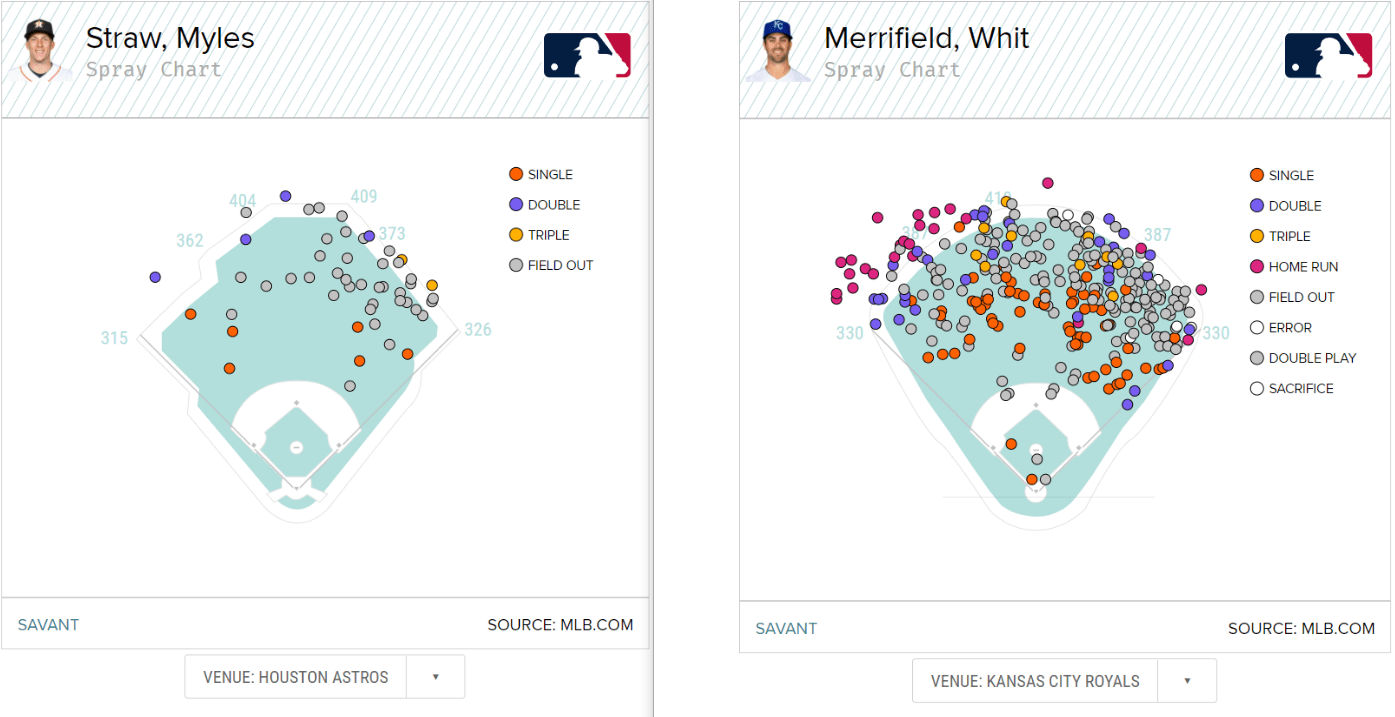
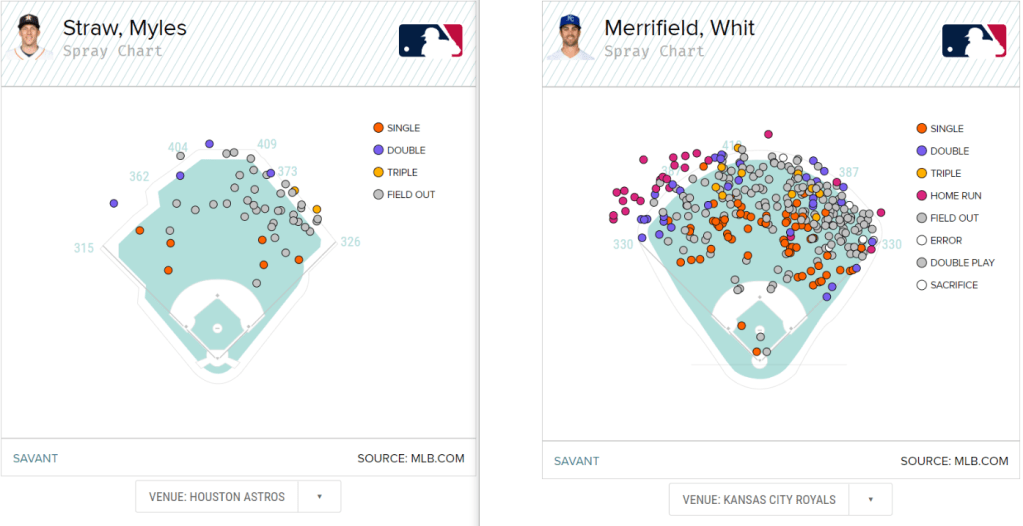
Merrifield is pretty low power, but he has a lot more power than Straw, and as I detailed here, to hit home runs Merrifield has to pull the ball. Even if Straw manages to hit a few balls in the air at 95+mph, does he pull it when he hits it in the air? No. Here is his 2019-2020 spray chart for batted balls greater than 15 degrees (with Merrifield’s for comparison):
If you like numbers better than pictures, according to Fangraphs, Straw pulled exactly 1 of his 49 flyballs in 2019-2020. So, to cut to the chase (after that meander, I appreciate it if you are still reading), we could have just looked at this:
Season
Tm
PA
GB/FB
LD%
GB%
FB%
IFFB%
HR/FB
IFH%
BUH%
Pull%
Cent%
Oppo%
Soft%
Med%
Hard%
2019
HOU
128
1.67
22.90%
48.20%
28.90%
4.20%
0.00%
10.00%
0.00%
22.40%
41.20%
36.50%
17.60%
50.60%
31.80%
2020
HOU
86
0.84
22.00%
35.60%
42.40%
4.00%
0.00%
14.30%
0.00%
31.70%
30.00%
38.30%
10.00%
63.30%
26.70%
Straw’s GB/FB ratio went from 1.67 in 2019 to 0.84 in 2020. Flyballs are very nearly automatic outs for Straw – four doubles and three triples in 50 batted balls (and a few flair singles) in the > 15 degrees sample, and one of his 2019 triples was with Jorge Soler in right field and the other was with Domingo Santana, and both could have been caught (probably should have, at least in the Soler case). If you delve through StatCast, you can find that Straw generally does great up through 19 degrees launch angle. Whether by design, or just being “off,” Straw hit too many balls at higher than that launch angle in 2020.
So, yeah, Straw was a horrible mess in 2020, both in his plate discipline and his batted ball metrics. And the two may well have gone hand-in-hand. But in 2019, and in his MiLB career, I think Straw has shown just enough hitting ability to make his skillset work. Hopefully with a full Spring Training, Straw gets the needed reps to get his approach locked in with an average launch angle around 10 degrees, and can then make the necessary adjustments to attack pitchers pounding the zone on him in 2021. If so, Straw could be at least adequate in 2021, and my 22nd round Draft Champions pick could pay off.
Whit Merrifield was kind of bad versus fastballs in 2020. Am I worried? Yeah, maybe a little.
There has been a fair amount of skepticism regarding Merrifield as a good Roto pick at his current ADP (around pick 35-40), and I really like Merrifield as a fantasy asset, so my reflexive response when I hear Merrifield skepticism on a podcast or read it somewhere is to basically blow it off: He’s old and slowing down? Maybe, but maybe not, and in any case, he is still fast, and besides a weird stretch in 2019, he is a legit 80% base stealer… He doesn’t hit the ball hard? Big deal! He never has, and he has been super-consistent in his exit velo and launch angle, and his metrics in 2020 were not that different. Oh, but they were. So, this will not be a post about Merrifield’s SBs (short version of that post: if he hits ok, he will steal 25-30 bags, maybe more, if he is feeling frisky), but it will delve, semi-deeply, into his 2020 batted ball stats.
In his career Whit Merrifield has been a pretty consistent hitter, with mediocre exit velocity and good, and consistent, launch angles. This could go into a lot of detail, but let’s not: take it as a given that year-to-year, 2016-2019, things were pretty close, and his year-to-year differences in home runs and BABIP seem to come mostly down to luck. Maybe there is more to it, but I couldn’t figure it out in a couple hours of looking.
So, his Statcast line for 2016-2019:
ba
iso
babip
slg
woba
xwoba
xba
launch_speed
launch_angle
0.296
0.149
0.340
0.445
0.337
0.335
0.280
87.3
15.9
Merrifield Statcast Metrics (2016-2019) via BaseballSavant
That’s not bad. He’s a pretty good hitter. Does not hit the ball very hard, but he gets the job done. We already knew that. In general, why it works for Merrifield, or did from 2016-2019, is that he doesn’t pound too many balls into the ground, and his balls in play are spread pretty evenly from -5 degrees to 35 degrees launch angle (and, at least somewhat, around the field), and he ends up around 15 degrees average launch angle – a little of this, a little of that, and it works for his moderate (at best) power.
Here is his 2020 Statcast line:
ba
iso
babip
slg
woba
xwoba
xba
launch_speed
launch_angle
0.282
0.157
0.295
0.440
0.324
0.324
0.292
85.6
15.3
Merrifield Statcast Metrics (2020) via BaseballSavant
That looks pretty much the same. End of post? Nope. Launch angle is the same. Woba is basically the same. Slg, too, etc. But not BABIP, and not launch speed. Before I looked into it, I simply chalked this up to Covid-related short season weirdness. And, in the end, that of course could be a factor. But his iso and slg (and thus his woba) are propped up by his increased homerun rate: 49 PA per HR prior to 2020, and 29 PA per HR in 2020. His other extra base hits were way down in 2020. He legit hit HRs at a decent rate (and 8/9 of the HRs were mashed (one wall-scraper in Detroit) – maybe they were “Merrifield mashed” (96 mph to 105.5 mph), but they were not wall scrapers… he pulled them, and there is one clue). When he hit a ball hard in the air, he pulled it, often for a HR, and otherwise? Not so great.
Merrifield earned his 2020 HRs, but maybe not in a particularly sustainable way. Six of his nine HRs were hit between 98 mph and 102 mph. One was hit at 105.5 mph (his hardest-hit ball of 2020), one was hit at 95.5 (the Detroit wall-scraper), and one was hit at 96.5. All were pulled at between -35 degrees and -15 degrees. If you look at Right-handed batters in 2020, and limit the results to this concocted “Whit Zone”, Merrifield is the leader in HRs:
Whit Zone %
player_name
HR_Tot
Whit Zone HRs
100.0%
Whit Merrifield
9
9
31.8%
Luke Voit
22
7
58.3%
Renato Nunez
12
7
50.0%
Wilmer Flores
12
6
31.3%
AJ Pollock
16
5
45.5%
Brian Anderson
11
5
31.3%
Pete Alonso
16
5
25.0%
Adam Duvall
16
4
66.7%
Albert Pujols
6
4
40.0%
Andrew McCutchen
10
4
44.4%
Anthony Rendon
9
4
40.0%
Edwin Encarnacion
10
4
80.0%
Garrett Hampson
5
4
2020 “Whit Zone” Home Runs
Merrifield was harvesting, like a Brian Dozier (with less power), or a late-career Ian Kinsler. Speaking of Kinsler, here is the 2017 “Whit Zone” table:
Whit Zone %
player_name
HR_Tot
Whit Zone HRs
95.5%
Ian Kinsler
22
21 (yikes!!)
58.8%
Brian Dozier
34
20
51.4%
Nolan Arenado
37
19
75.0%
Zack Cozart
24
18
78.9%
Kurt Suzuki
19
15
78.9%
Whit Merrifield
19
15
I digress, but only sort of. Two things: 1: Merrifield has always hit his HRs this way – that should be expected, as a low-power RHH; he just took it to extremes in 2020. 2: If Merrifield is morphing into late-career Kinsler, that is not a good thing (or into Zach Cozart, for that matter).
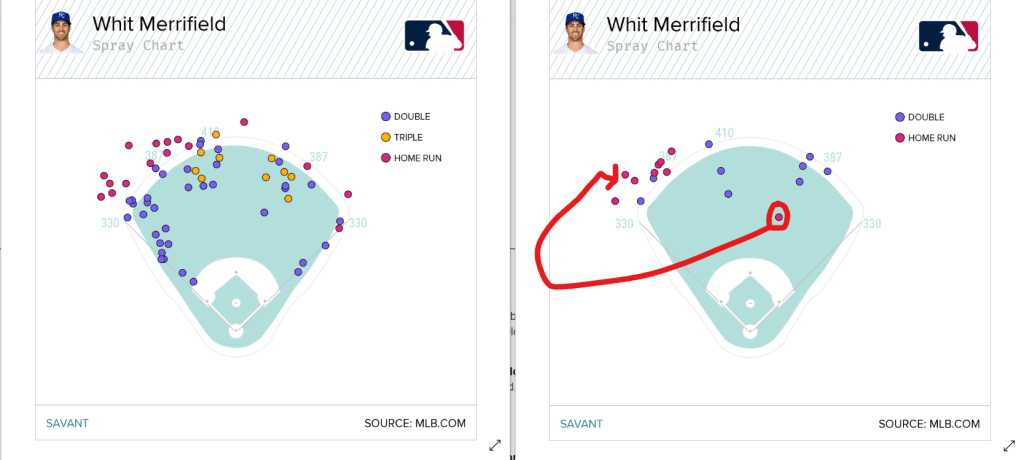
Is all this just not a big deal? Maybe, because, like I just wrote: Merrifield just took his homer approach to an extreme in a short season sample. In a longer season, maybe he stumbles into an oppo HR or two, or blasts one to, god forbid, at least somewhere to center of left-center. Compare his 2020 and 2019 airball extra base hit spray charts:
Whit Merrifield Airballs, 2019 (on the left) and 2020. As noted with the fancy red arrow, that bloop to right field was actually a home run to left.
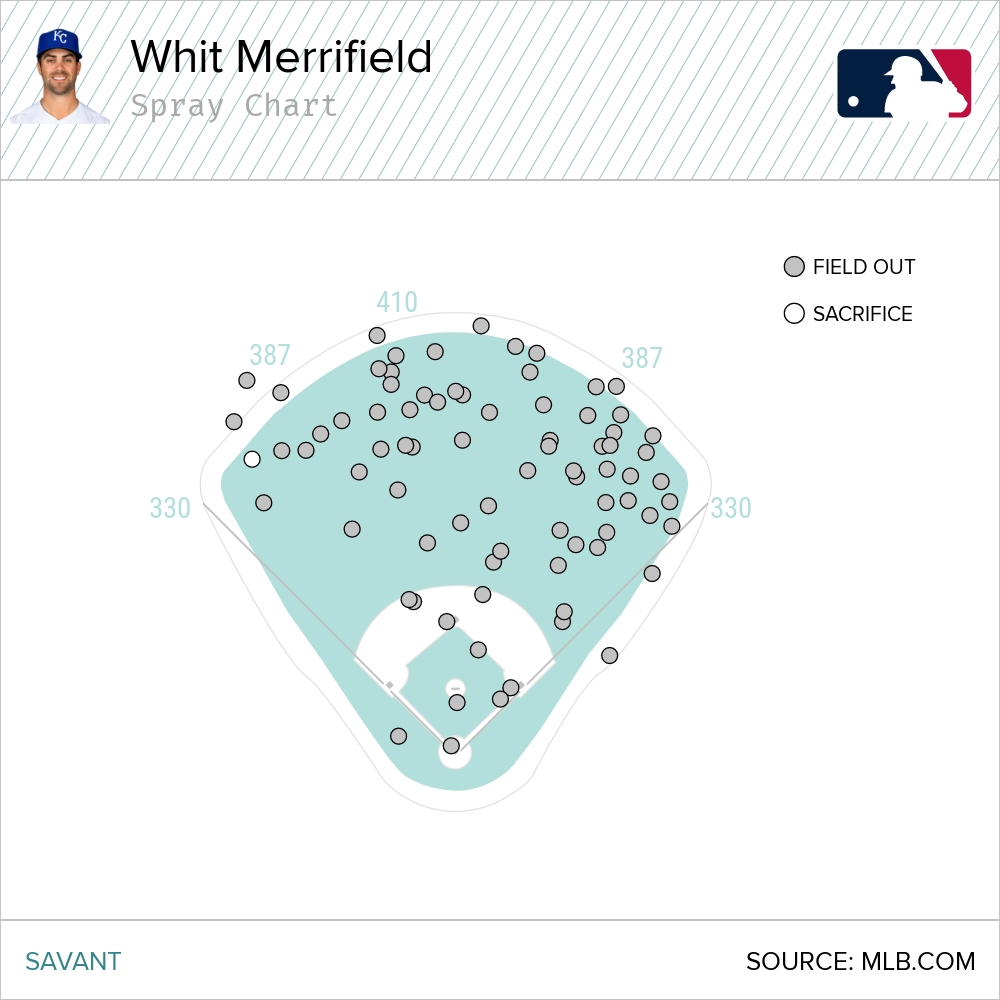
2019: predominately doing his extra base damage to left, but a decent smattering to center, right-center, and right. 2020? Bombs to left, and just a few fliners to left-center and right-center. Granted, his three 2019 oppo HRs were pretty lucky: an inside-the-parker, a Yankee Stadium special, and a well-hit but wind-blown fly ball literally off the top of the fence in KC. But at least he gave those two that got over the fence a chance; in 2020, barely anything got close unless he pulled it. No triples in 2020, and very few doubles. Given his batted balls in 2020, he simply didn’t earn many extra base hits. Here are Merrifield’s 2020 airball outs:
Merrifield Airball Outs, 2020
Not a lot getting to the fences, and a lot of medium contact. Via Fangraphs, he basically swapped 16% of his Hard air contact for Medium contact:
Merrifield Flyballs and Line Drives
Merrifield still spread the ball around, and still kept his launch angle tight enough to get a bunch of singles and not tank his batting average. But that drop in hard contact, especially to center field and right field, killed his extra base hit rate. Why did this happen?
To circle back to the beginning: Merrifield had a lot less power versus fastballs, unless he pulled them. Versus fastballs, when he didn’t pull it, his exit velocity was down nearly 2 mph, and his iso was down 0.169 points.
year
ba
iso
babip
slg
woba
xwoba
xba
Exit Velo
Launch Angle
2019
0.390
0.238
0.375
0.628
0.420
0.449
0.408
89.8
29.0
2020
0.397
0.069
0.397
0.466
0.369
0.396
0.404
88.0
29.3
Merrifield versus Fastballs – non-pulled Flyballs, Pop Ups, and Line Drives
So, am I now out on Merrifield in 2021 at his current ADP? I am no longer blowing off the Merrifield doubters, and I won’t push him up, but if I want my speed early and he is there, I may still grab him. If all he hits is homers and singles, his BA may drop a bit, and he will likely be a worse hitter, but it may not hurt his SB total. And, 2020 may have been a bit fluky – Merrifield’s swing maybe could have just been a bit off, and he may regain a bit of his oppo fly ball and liner oomph. If I want SBs at that point, I am still buying, but hopefully at around pick 45 rather than pick 35.
Who? Anthony Misiewicz was very good in 2020. This fact is not reflected (nor should it necessarily be) in his prospect graduation one-liner at Fangraphs: “After exhausting his rookie eligibility in 2020, Misiewicz projects as a low-leverage multi-pitch bullpen lefty.” Based on his minor league background, that is who he should be, and he may yet be that, but that is not at all what he was in 2020. Because in addition to being very good in 2020, Anthony Misiewicz was also nearly unique in his pitch mix – or at least as unique as we can say anyone is in a 20 IP sample size.
Rotowire hints at there being more there to Misiewicz in their 2021 outlook: “(Misiewicz) logged a solid 4.05 ERA, but his 3.04 FIP and 3.27 SIERA were even more encouraging. Misiewicz has a middling 94.1 mph average fastball velocity, but his cutter is his primary pitch, and he leans heavily on his curveball as well.”
Misiewicz certainly featured the cutter: he threw it 52.7% of the time (all data gathered via Fangraphs). What is so unique about featuring a cutter? Not much, these days, but if one narrows it down to those pitchers that really FEATURE the cutter, the list is actually pretty short: of the 412 pitchers that slung at least 15 IP in 2020, only 20 used the cutter for at least 40% of their offerings (if one fudges it to 39.9% to include Yusei Kikuchi). At around 40% cutter usage there are a few three- (or more) pitch guys, but Misiewicz was basically the only three-pitch guy in 2020 with a cutter rate greater than 50%.
In order to come up with a larger set of Misiewicz pitch mix comparables, I lowered the bar to 30% cutter usage and tossed out all pitchers with 5% or greater changeup usage (Misiewicz had a changeup in the minors, but threw zero in MLB in 2020): What is immediately obvious on this list is that four additional guys need to go, as they basically don’t even throw their fastball. This is actually pretty instructive, because it gives us an indication of one thing Misciewicz was not in 2020: he was not a “Mark Melancon” (cutter-breaker-only guy).
Misiewicz Comps, sorted by lack of fastball Usage:
Name
Team
Fastball%
Cutter%
Slider+Curveball%
SplitFinger+Changeup%
Will Harris
WSN
0.0%
77.7%
22.3%
0.0%
Andre Scrubb
HOU
0.0%
52.6%
47.4%
0.0%
Colten Brewer
BOS
2.0%
45.3%
52.4%
0.4%
Mark Melancon
ATL
3.4%
54.5%
38.7%
3.4%
Josh Tomlin
ATL
19.5%
50.8%
26.1%
3.7%
Brooks Raley
– – –
23.2%
44.3%
28.8%
3.6%
Anthony Misiewicz
SEA
24.1%
52.7%
23.2%
0.0%
Yu Darvish
CHC
24.8%
40.2%
27.0%
7.9%
Brandon Workman
– – –
26.3%
34.2%
39.5%
0.0%
Alex Colome
CHW
28.3%
71.7%
0.0%
0.0%
Kenley Jansen
LAD
28.5%
61.9%
9.6%
0.0%
Travis Lakins
BAL
32.6%
41.9%
22.3%
3.2%
Dan Winkler
CHC
33.1%
55.9%
10.7%
0.3%
Cy Sneed
HOU
36.1%
33.4%
28.9%
1.5%
Josh Osich
– – –
37.2%
47.7%
15.1%
0.0%
Yusei Kikuchi
SEA
37.7%
39.9%
16.1%
6.3%
Chris Mazza
BOS
38.9%
30.0%
27.9%
3.2%
Shawn Armstrong
BAL
43.0%
46.0%
11.0%
0.0%
Tommy Hunter
PHI
43.2%
33.7%
23.2%
0.0%
Ryan Tepera
CHC
46.1%
43.6%
5.1%
5.1%
Jacob Barnes
LAA
46.6%
51.5%
1.0%
1.0%
Jesse Chavez
TEX
49.3%
31.7%
13.7%
5.2%
Kyle Ryan
CHC
52.6%
38.8%
8.6%
0.0%
Justin Wilson
NYM
59.4%
37.1%
3.5%
0.0%
After removing the Melancons, I then lopped off the guys with less than 10% breaking ball usage. This is more than a bit arbitrary, as it removes Kenley Jansen and keeps Dan Winkler, for example. But we all know that Jansen is really a two-pitch guy, with just the occasional slider (12% usage in 2019 was his career high), and not that I particularly care about Dan Winkler right now, but his 10.7% 2020 slider rate was a career low (maybe he turned into a 2-pitch guy in his 18 IP in 2020, but historically, his slider rate is more like 20%). Anyway, I am also removing the “Alex Colomes” (cutter-fastball-only guys).
Minus the Melancons, and now sorted by lack of breaking ball usage. The first six guys below will also get axed:
Name
Team
FB%
CT%
SL+CB%
SF+CH%
Alex Colome
CHW
28.30%
71.70%
0.00%
0.00%
Jacob Barnes
LAA
46.60%
51.50%
1.00%
1.00%
Justin Wilson
NYM
59.40%
37.10%
3.50%
0.00%
Ryan Tepera
CHC
46.10%
43.60%
5.10%
5.10%
Kyle Ryan
CHC
52.60%
38.80%
8.60%
0.00%
Kenley Jansen
LAD
28.50%
61.90%
9.60%
0.00%
Dan Winkler
CHC
33.10%
55.90%
10.70%
0.30%
Shawn Armstrong
BAL
43.00%
46.00%
11.00%
0.00%
Jesse Chavez
TEX
49.30%
31.70%
13.70%
5.20%
Josh Osich
– – –
37.20%
47.70%
15.10%
0.00%
Yusei Kikuchi
SEA
37.70%
39.90%
16.10%
6.30%
Travis Lakins
BAL
32.60%
41.90%
22.30%
3.20%
Anthony Misiewicz
SEA
24.10%
52.70%
23.20%
0.00%
Tommy Hunter
PHI
43.20%
33.70%
23.20%
0.00%
Josh Tomlin
ATL
19.50%
50.80%
26.10%
3.70%
Yu Darvish
CHC
24.80%
40.20%
27.00%
7.90%
Chris Mazza
BOS
38.90%
30.00%
27.90%
3.20%
Brooks Raley
– – –
23.20%
44.30%
28.80%
3.60%
Cy Sneed
HOU
36.10%
33.40%
28.90%
1.50%
Brandon Workman
– – –
26.30%
34.20%
39.50%
0.00%
That leaves 13 comps, and Misiewicz, with former starter Josh Tomlin the closest comp, purely based on 2020 pitch mix. If we limit this to the single-inning-relief-pitchers (SIRPS), we are left with a few guys somewhat close to Misiewicz’s mix – not super close, but somewhat; and in a 20 IP season, I probably shouldn’t limit this much more. What we do see is that some guys have made this approach work at least well enough to stick around. And also… Yu Darvish (he adds in the splitter and change at a total of 8%, but has morphed into a cutter-first guy, for sure), so there is that. As well as Misiewicz’s teammate, Yusei Kikuchi, which is kind of cool, but (probably) a coincidence.
Final Misiewicz comp list, sorted by cutter usage:
Name
Team
FB%
CT%
SL+CB%
SF+CH%
Who’s this Guy?
Career FIP
Dan Winkler
CHC
33.10%
55.90%
10.70%
0.30%
journeyman SIRP**
3.91
Anthony Misiewicz
SEA
24.10%
52.70%
23.20%
0.00%
We don’t yet know
3.04
Josh Tomlin
ATL
19.50%
50.80%
26.10%
3.70%
journeyman swingman
4.65
Josh Osich
– – –
37.20%
47.70%
15.10%
0.00%
journeyman SIRP
5.02
Shawn Armstrong
BAL
43.00%
46.00%
11.00%
0.00%
journeyman SIRP
4.28
Brooks Raley
– – –
23.20%
44.30%
28.80%
3.60%
He is… interesting
5.43*
Travis Lakins
BAL
32.60%
41.90%
22.30%
3.20%
Righthanded Misiewicz?
3.83
Yu Darvish
CHC
24.80%
40.20%
27.00%
7.90%
Superstar, but maybe a comp?
3.43
Yusei Kikuchi
SEA
37.70%
39.90%
16.10%
6.30%
This too is interesting
5.17
Brandon Workman
– – –
26.30%
34.20%
39.50%
0.00%
Also, sort of, RHP Misiewicz? But too many BBs
3.90
Tommy Hunter
PHI
43.20%
33.70%
23.20%
0.00%
Former starter. He’s had a good run as a SIRP
4.29
Cy Sneed
HOU
36.10%
33.40%
28.90%
1.50%
Young SIRP. Pitching in Japan in 2021.
4.78
Jesse Chavez
TEX
49.30%
31.70%
13.70%
5.20%
journeyman swingman
4.38
Chris Mazza
BOS
38.90%
30.00%
27.90%
3.20%
Longtime minor leaguer. Might carve out a swingman role
4.00
* Raley spent five years in the KBO, so his career FIP is pretty meaningless **SIRP = Single Inning Relief Pitcher
So, is Misciewicz unique? He used a rare approach in 2020, but not quite unique. If he does it again in 2021 (50%+ cutters and 20%+ for both the fastball and the breaker) we shall revisit things. The primary takeaway may be that Misiewicz seems adaptable. This is good. He was previously pegged as (at best) a multi-pitch swingman with so-so stuff. Presumably he pitched off his fastball coming up through the minors with multiple usable pitches, but nothing plus. When moved to a SIRP role at the MLB level, the fastball took a backseat (but with some added mph), and he completely ditched the changeup… and integrated a cutter as his primary pitch (a pitch that wasn’t even listed in his 2020 prospect report – did he just learn it last year and then throw it over 50% of the time?).
Why did this work? I didn’t try to get into that too deeply. But on the surface it makes sense: he threw strikes, he threw hard, and he wasn’t predictable: he was 63% cutter on the first pitch of the at bat, and on 1-2 and 3-2 counts to LHHs he threw the cutter on 20 out of 22 pitches; but while he still emphasized the cutter in other situations, it was more 30%/30%/40% FB/CB/CT in other situations.
Maybe he’ll keep the same approach in 2020. Maybe he’ll pull out the changeup occasionally versus RHP (RHH hit him hard, but with a very good 20.5% K-BB% versus RHH – given the small sample it is hard to say how indicative the ball-in-play data is). Overall, his cutter was pretty good, his fastball did not get hit (almost literally), and his curve had bad results (but what can we really tell from ten fastballs hit into play and 22 curveballs in play?). Whatever the case, going into the 2021 season his role seems secure as the high leverage LHP for the Mariners. He doesn’t really walk guys (2.7 BB/9) (and never has: 2.5 BB/9 in MiLB). So if he keeps his fastball velocity above 94 mph (about average for a reliever these days, but definitely above average for a lefty reliever), while the curveball may be a crapshoot, it looks like the cutter and the fastball (and the control) are good enough for him to keep that role.
I’ve been drafting Misiewicz at the very end of NFBC 50-round Draft Champions contests (like this one), and as the LHP setup guy in front of a RHP closer, I expect him to stumble into a few saves (it may be on my bench, but such is often the case for a 50th round pick). He should be on your radar in that format, and also on your watchlist in any format that rewards holds.
This is the fourth in an at least six-part series of posts going over my 2021 NFBC Draft Champions rosters (at least six parts since I plan on having six or more DC teams). If you missed the first post, second post, and/or third post go ahead and check those out as well – they offer a bit of background on the NFBC DC format, as well as my (brief, yet successful) DC results from 2019 and 2020. One point to briefly repeat here: NFBC rosters lock for pitchers weekly, but allow the hitting lineup to be changed after Thursday each week.
Whereas I did my first three DC drafts more-or-less simultaneously, I had nothing else going on during this one (except for work at the real job, family life, and some time at the beach). Maybe that helped me focus a bit more on this one, but it is hard to say for sure – if it is better (or worse), that probably has as much or more to do with timing (a lot of player signings occurred after my first three drafts were done), as it does with not doing multiple drafts at the same time.
For this draft, I went with my normal inclination and wanted a pick in the 9-12 range…and got my sixth priority (14th). Not ideal, but here is how it went. (ADP cited is for NFBC DC drafts from 1/25 through 2/21.)
Pick 14: Freddie Freeman. There are no bad picks in the first round. A unique and amazing hitter. He is so good, it seems like nobody bothers to analyze him. Or maybe they (we) do, and it is really pretty simple: he consistently hits the ball hard enough, at around the ideal launch angle.
Pick 17: Trevor Story. There are no bad second round picks either, but it is a fateful choice – it can determine the path of the rest of the draft. I skipped SP here, knowing I would not get another crack at one until pick 44. My choice was down to Trevor Bauer or best hitter available (I already have shares of Walker Buehler and Aaron Nola, the other two available SPs worth considering), and, while I am not purposefully avoiding Bauer… on second thought, I kind of am purposefully avoiding Bauer…anyway, I went with best hitter available with sure-thing SBs. This was prior to Bauer signing with the Dodgers, but I think I would have gone with Story regardless.
Pick 44: Zac Gallen. So, I lucked out and Gallen was still on the board. I got Gallen right after Tyler Glasnow and Lance Lynn were taken, and I have Gallen ranked above them (Strasburg, Fried, Carrasco, and Burnes were the next four SPs taken after Gallen).
Pick 47: Randy Arozarena. How real is he? Pretty real. The previous pick was Starling Marte. I wanted the SBs, so I preferred Arozarena over George Springer (and over Trent Grisham due to batting average… I hope). Possibly more pertinent: I didn’t get another SP here. We will see how that strategy plays out (hint: FantasyPros Draft Wizard tells me that my weaknesses are: “W, K, ERA, WHIP”… huh).
Pick 74: Nick Castellanos. He had a weird BABIP year, and also struck out more (due to a lot more swing-and-miss, inside and outside the zone). I did not dig deeper than that, and simply hope he was out of whack due to the weird season.
Pick 77: Eugenio Suarez. 2020 was a very bad BABIP year for Suarez, seemingly due to some luck, and some of what I like to call “being worse” (he traded a bunch of hard contact for medium contact, and most of everything else looks similar). I should have a good enough batting average base to take on Suarez’s BA risk. I jumped both Cincinnati guys (slightly) ahead of ADP, as I did not prefer the SP choices available, and I hoped that I might get a similar quality SP on the next shot.
Pick 104: Ryan Pressley. A good closer, with the job, picked at value.
Pick 107: Zack Greinke. He was pretty good last year, and throwing harder as the year wore on. He’s my SP2? This could work. I don’t have elite strikeouts from my first three pitchers, but it should be enough to hang in there.
Pick 134: Dylan Moore (ADP: 126). My second Dylan Moore share (the first was at pick 102, so I was plenty ok with taking him at pick 134). He made a swing/approach change last year, and it (obviously) worked, at least in the small-sample season of 2020.
Pick 137: Pablo Lopez (ADP: 122). I am beginning to see why my strikeout projection is kind of “meh”. But Lopez did strike guys out last year, and was great, basically – traditional stats are backed up by the advanced / Statcast metrics. His year deserves a deep dive – on the surface, beyond the great results, all that jumps out is his lowering his curveball rate down to 9% and incorporating a cutter.
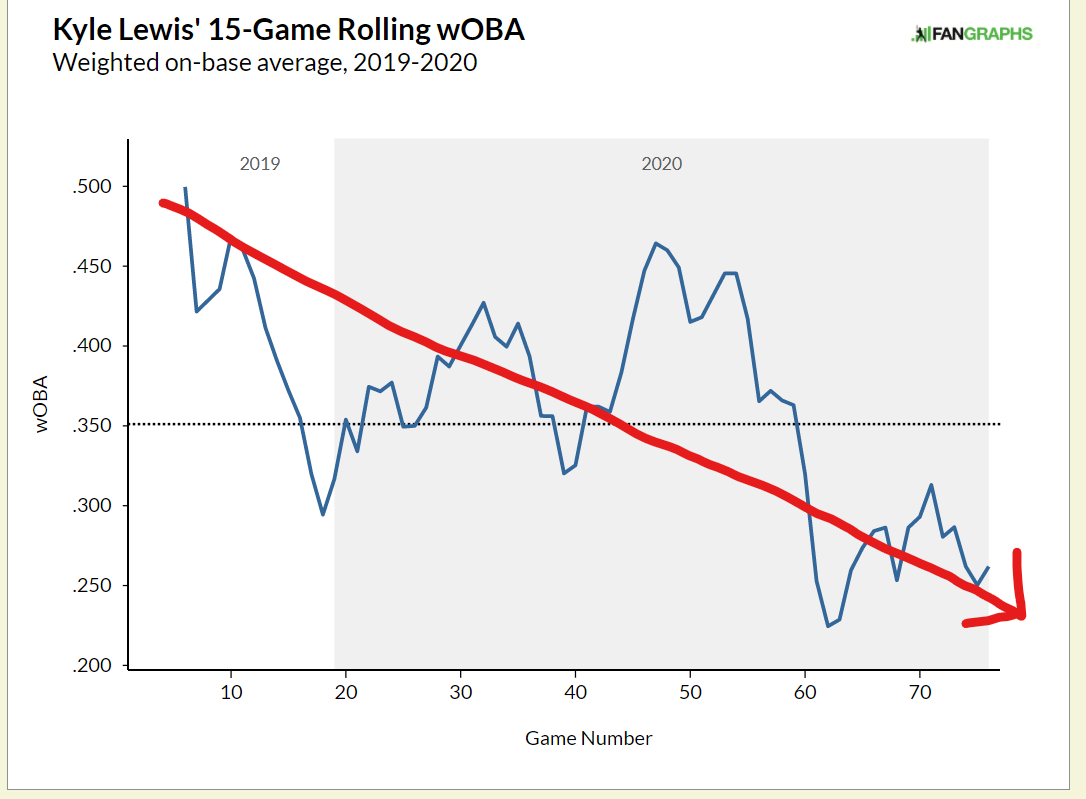
Pick 164: Kyle Lewis (ADP 146). Is he bad? By the end of 2021, his wOBA may be zero (see entirely accurate trend line sketched below). I made some picks late in the draft to attempt to mitigate for the possibility of his being not good.
Pick 167: Nick Solak (ADP: 164). Dual-eligibility (2B/OF) helps. Some power, some speed, should have good BA. The rumblings regarding his defense limiting his playing time are disconcerting, but the bet is he hits enough to make those concerns moot.
Pick 194: Trey Mancini (ADP: 2189). He was great in 2019. No need for speed here, so Mancini’s combo of good power and hopefully good BA fits the bill (and 1B/OF eligible). All the news indicates he is 100% after his season missed to colon cancer treatment.
Pick 197: John Means (ADP: 254). His projections are stinky poop. He will crush them. If he doesn’t? My team may suck.
Pick 224: Buster Posey (ADP 280). I’m all in on Posey. A big advantage of a DC is the ability to handcuff catchers – you don’t want to just burn roster spots, but spending a 28th round pick on Joey Bart (not in this draft) and/or a 37th on Curt Casali? Whatever. It’s worth it to shoot for the upside of Posey over the typical random detritus of the catcher position.
Pick 227: Hunter Dozier (ADP: 238). Dozier had Covid, so I am tossing out his 2020 line. I expect a BA bounce back and good power, with chip-in SBs, along with 1B/OF eligibility (and 3B as well, a week into the season).
Pick 254: Jordan Hicks (ADP: 237). If he is good (good to go, recovering from 2019 TJ surgery, and …good), he is the closer in STL.
Pick 257: Greg Holland (ADP: 227). If things work out, this team will do well in saves. Holland may not be the stud he once was, but he is as sure a bet as any closer outside the top 5 or so (although possibly a late-season trade candidate).
Pick 284: Tom Murphy (ADP: 326). Seriously, people: “over drafting” catchers is worth it in a DC, if you handcuff them (I “over drafted” Luis Torrens at pick 374 (ADP: 434) to pair with Murphy). In one of my DC drafts I may try to mostly punt my C2, but in general, I think it is a pretty bad idea.
Pick 287: Joey Wendle (ADP: 313). 2B/3B/SS eligible. Should supply BA and some SBs. I paired him with Mike Brosseau at pick 434 to mitigate his being somewhat platooned.
Pick 314: Josh Lindblom (ADP: 315). A 5.16 ERA last year, but the underlying stats portend better (3.88 FIP, 87.8 mph average exit velocity), as he was bad with men on base (his wOBA allowed was .079 higher with men on, leading to a 65% strand rate). Hopefully that was mostly random. If so, I like him as my SP5.
Pick 317: Brad Keller (ADP: 318). My SP6. He was supposedly working on a curveball last spring, but ended up not using it in-season. He didn’t need it, but maybe with a more-normal season, we see him give it a try. Whatever the case, he is a fine fantasy SP6, especially since he should be a pretty good bet for a fairly normal IP total, which somewhat makes up for his low K/IP ratio.
Pick 344/347: Andrew Vaughn (ADP: 317) and Adam Eaton (ADP:331). Eaton currently slots in as my last starter, with Vaughn on the bench. I have plenty of roster flexibility to slide Vaughn in at Corner or Utility if he is up and produces.
Notable reserve picks (fully listed in the picture below):
Luis Arraez in round 26. I had him on multiple teams last year. I knew his drawbacks then, and I certainly still do. But he was also not fully healthy last year, and still hit .321. He also may get OF eligibility early in the season, which counteracts his slight dip in expected playing time (and he also might, generally, slot higher in the lineup than he did last year).
Bryan Garcia / Gregory Soto (round 27 / round 35). The likely Saves-producers in Detroit. I need to dive into Garcia’s pitch mix from last year, as his 5.0 K/9 does not jive with his career 11.5 minor league K/9.
Jared Oliva / Anthony Alford (round 28 / round 38). I have a lot of confidence that Oliva is ready and will be good. I drafted Alford just in case Pittsburgh gives him a long leash and he is decent enough to stick and hold off Oliva.
Randy Dobnak (round 30). He was the Twins expected #5 starter when I made this pick. I follow the Twins closely, so I knew there was a chance he would be bumped to the #6 slot.
Curt Casali (round 37). The aforementioned Posey insurance.
Leury Garcia (round 39). Andrew Vaughn / Adam Eaton insurance.
Taylor Trammell / Jake Fraley (round 41 / round 45). In case Kyle Lewis is bad. Even if Lewis is good, Trammell could be playing nearly full time and providing SBs by mid season.
Jhoan Duran (round 48). He will be up and contributing to the Twins at some point, and serves as a backup to my Dobnak pick.
Anthony Misiewicz (round 50). I am one of the few drafting Misiewicz (he was picked in 4 of 44 DC drafts for the ADP period I am citing). A separate post on Misiewicz is forthcoming.
I haven’t run this through any projections. That will be part of a future post where I plan on comparing my DC teams. My first three DCs will be compared to each other as they were mostly simultaneous, and this draft will be compared to those in a separate post.
This is the third in an at least six-part series of posts going over my 2021 NFBC Draft Champions rosters (at least six parts since I plan on having six or more DC teams). If you missed the first post, and/or the second post, go ahead and check those out as well – they offer a bit of background on the NFBC DC format, as well as my (brief, yet successful) DC results from 2019 and 2020. One point to briefly repeat here: NFBC rosters lock for pitchers weekly, but allow the hitting lineup to be changed after Thursday each week.
This draft was actually my first 2021 DC – the other two written up so far went pretty quickly (all three were a four-hour clock between picks for the first 30 rounds and two hours for rounds 31-50), and this one lagged, and lagged… to the point that it took five days longer. Yikes. But that’s just the way it goes sometimes.
For this draft, I went against my normal inclination and preferred an early draft slot, and got my second choice (third) via the NFBC’s Kentucky Derby Format (KDF). Here is how it went.
Pick 3: Juan Soto. As expected, Acuna and Tatis went 1/2, and I was dead set on taking Mookie Betts at pick 3. Mookie is the better player, but Soto is the better hitter. Nothing really to analyze – it was just a gut pick.
Pick 28: Blake Snell. I wanted to get a share of Blake Snell, and I had just experienced Snell going at pick 19 in my first-completed draft. So I jumped on him at 28. Bummer that I couldn’t predict the future to realize I would be able to get him at pick 49 in the other draft covered a few days ago. He was the 9th SP of the board in this draft – maybe a bit early, and I know the drawbacks, but I have him as a toss-up with the next several SPs taken.
Pick 33: Whitt Merrifield. I love Whit Merrifield, and (mostly) trust that the SBs he provides will keep coming. I plan on digging deeper on why I love Whitt at some point.
Pick 58: Corbin Burnes. After the initial rush on aces, SPs were not especially flying off the board (OFs were, and I missed out on the OFs of that tier), so Burnes was there for my #2SP as the 21st SP taken.
Pick 63: Liam Hendricks, at right around ADP. Sometimes I hit RP early. I have some mild trepidation due to his changing home parks, but he should be great.
Pick 88: Edwin Diaz (ADP: 76). So, I doubled-up on high end closers for the heck of it. And ended a bit of a closer run (5th RP taken). Obviously, this could blow up in my face, or be fantastic.
Pick 93: Framber Valdez (ADP: 84). Is Framber worth the 31st SP pick (he’s 29th by ADP)? I think so, and plan on writing more about that in the coming weeks.
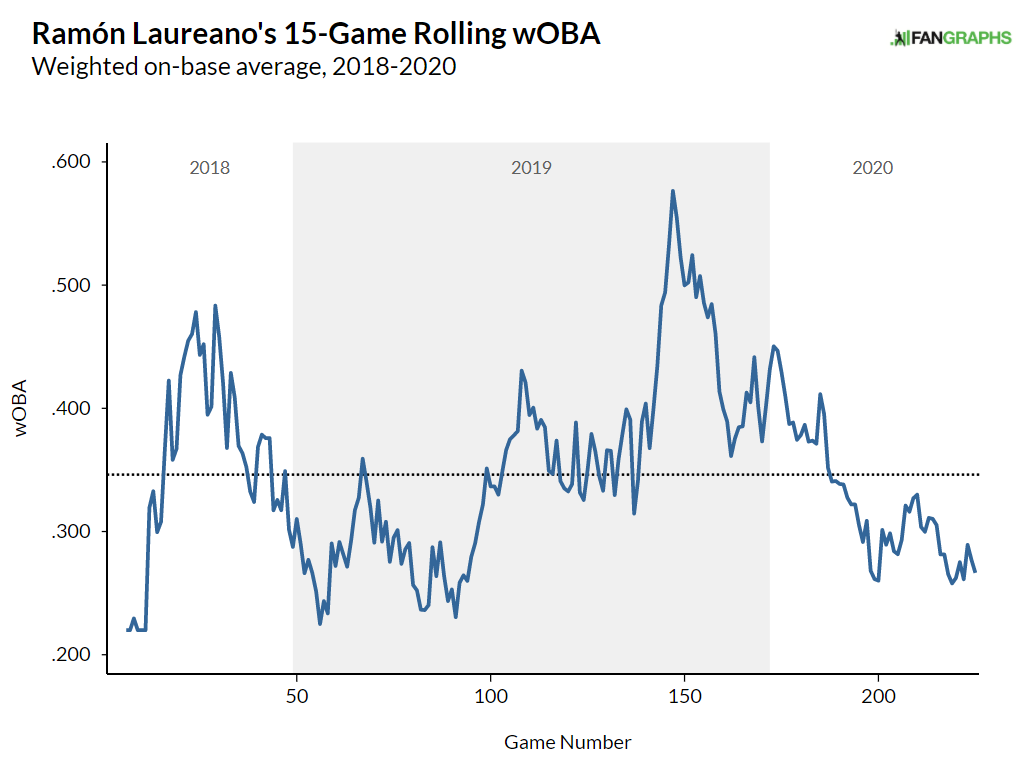
Pick 118: Ramon Laureano (ADP: 135). He went right after Byron Buxton and Wil Myers and the round before Dylan Carlson and Kyle Lewis (and two rounds prior to Tommy Pham). 2020 was a weird year for Laureano: 44% Hard Hit rate prior to his suspension, and 30% after. This is not especially encouraging:
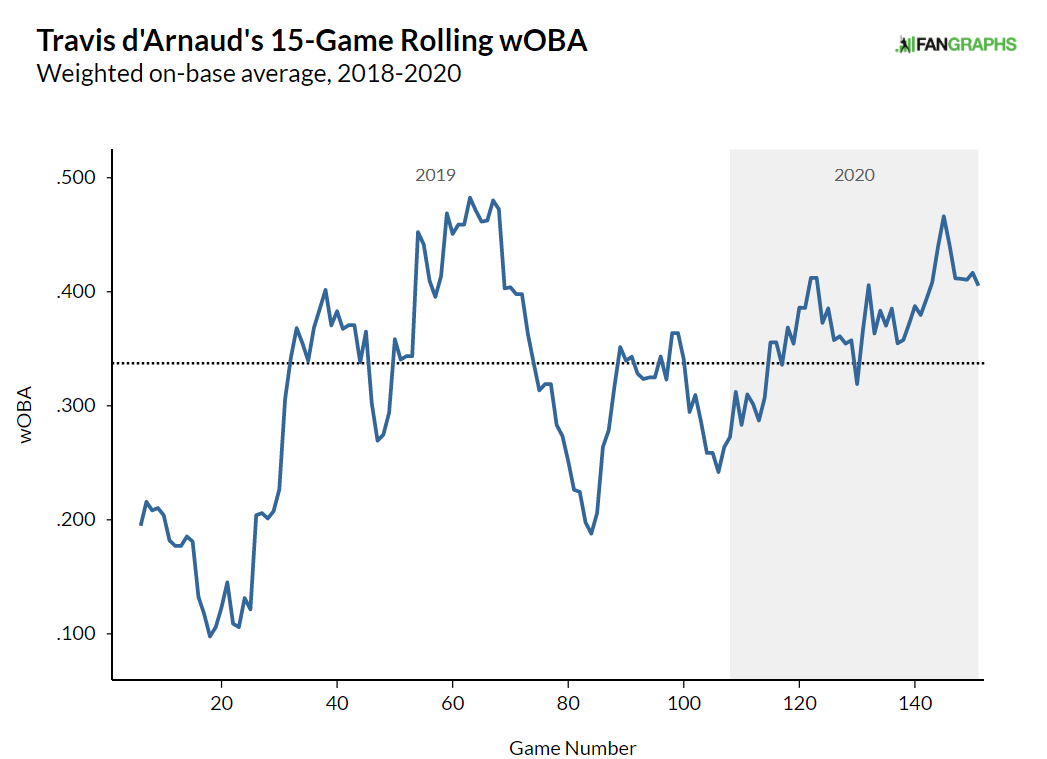
Pick 123: Travis d’Arnaud (ADP: 150). He was ridiculous last year: .392 wOBA, which he seemingly mostly earned (Statcast Hard Hit rate was 58%). Can he repeat it? Probably not. And his plate appearances would have pro-rated to 496 PA in a 162-game season, while he has topped 400 PA in a season just once in his career. But it is fun to dream on elite production from a catcher.
Pick 148: Tommy Pham (ADP: 117, Max: 133 (blown out of the water by my pick)). In a DC, I spend a fair amount of effort balancing categories, and getting depth. But sometimes (really, as much as one can), just grab the value, especially in the first ten rounds. Pham fell too far. He may be risky, but, as shown by ADP, his combo of skills really should go a lot higher than pick 148.
Pick 153: Kevin Gausman (ADP 114, Max: was 139, soon to be 153). Not without risk, but I needed SP, and this pick was as obvious as possible.
Pick 178: Ha-seong Kim (ADP: 161). This was prior to Profar signing with San Diego. Kim’s ADP was more like 150 during the time I made the pick. I still feel ok with it – I wanted at least one share of him, for his multi-category upside and likely multi-positional eligibility.
Pick 183: Jean Segura (ADP: 196). Potential multi-category contributor. Potential “meh.” Will be SS/2B/3B eligible. Which may not do me much good, as I sort of neglected to get another decent 3B.
Pick 208: Andrew McCutchen (ADP: 204). Average BA. Average SB. Average HR. Hopefully plus in R+RBI. An average-ish pick.
Pick 213: Miguel Sano (ADP: 195). Time to check in to see if I have enough BA and SB to cover for the Sano pick. Soto and Merrifield provide a good BA base, with assistance from d’Arnaud. The rest of my hitters so far should be ok for BA. Batting average is fickle. SBs: …yeah, it really depends: Merrifield, Pham, Laureano, Segura, McCutchen, Kim, and Soto all should contribute. Could be very good – maybe even good in the overall contest (but none are sure things). Possibly a bit light on HR to this point, thus, the Sano pick.
Pick 238: Jose Urquidy (ADP 280). He requires a somewhat deep dive. He had a positive Covid test and an uneven start to 2020. His Ks were way down, possibly due to diminished velocity on his slider. All his ERA estimators were bad, and one could chalk his shiny ERA up to luck. But… from an actual results standpoint, he was great (except for the low Ks). It is a small sample, but over his first two MLB years he has thrown four pitches at least 12% of the time each, and they all have had positive pitch values. He got pop ups, and he got a ton of medium contact. Lots of flyballs, but mostly not hard-hit: Across 2019+2020 – 19 soft, 38 medium, 32 hard (with 9 HR allowed). Is that good? I think so. Compare with a random RHP sinker-baller: 70 Hard Hit FB (2019-2020) with 31 HR (44%). Back to Urquidy: of his 32 Hard Hit FBs, only 9 were pulled (allowing 4 of his 9 FB HR, 44%) (RHP sinker dude: 31/70, for 21 out of his 31 HR allowed (68%)). I am sort of blathering, but the point is that even without decent Ks, Urquidy was good, and it was maybe not all luck based – he may have a skill of inducing medium-hit and non-pulled flyballs (which also really suits his home park). If he get the Ks back up, he could be a great bargain here. (Random RHP sinker-baller is Kyle Gibson, btw – I didn’t say “good” – Gibson was just the first pitcher I thought of).
Pick 243: Randall Grichuk (ADP: 197). Blurgh. This was prior to the Springer signing. I also have the max pick (252) on Grichuk in another DC. I really like Randal Grichuk. This could still work out.
Pick 268: Michael Pineda (ADP: 235). He’s good, and I was glad to get him at good value. Keeping it short here after the Urquidy ramble.
Pick 273: Alejandro Kirk (ADP: 298). Trying to protect BA. As Kirk’s playing time may be uncertain, I got a viable 3rd catcher early in the reserve rounds. I probably should have gotten a second 3B-eligible player here (Eduardo Escobar, Joey Wendle, and Kyle Seager all went prior to my next pick).
Pick 298: Wilmer Flores (ADP: 326). In addition to lack of 3B depth, I realized I only had one 1B-eligible player at this point. Got Flores for his additional 2B eligibility; and, he can hit. It would help his playing time if the NL gets the DH (and this pick was before the Tommy La Stella signing). San Francisco will be Platoon City, even with the DH, and playing time may be scarce if no DH. Two picks in a row that are not looking fantastic.
Pick 303: Tejay Antone (ADP: 324). Intriguing skills, and great results in a small sample. Role is uncertain – outside chance at saves, but likely more valuable to Reds in a multi-inning role.
Pick 328: Lucas Sims (ADP: 328). Three-pitch RP with decent Ks and WHIP. Has a decent chance at saves. Also spreading my shares around a bit, as I got Amir Garrett at about the same spot in another DC.
Pick 333: Brandon Belt (ADP: 336). Depending on how playing time shakes out in SF, I plan on using Belt in partial weeks where SF is facing more right-handed pitchers, and using Wilmer Flores when SF is facing more LHP.
Since Belt and Flores are basically a platoon, my starters go 24 rounds deep: Pick 358: Nico Goodrum (ADP: 373). 2B/SS eligible. He should contribute in four categories, while he kills me in batting average. He should give up switch hitting, or be sat versus RHP. I will need to get some decent infield reserves to make sure I don’t need to play Goodrum versus too many RHPs.
Notable reserve picks (fully listed in the picture below):
Jared Oliva in round 26. He should get a chance to play in Pittsburgh. Decent chance for a good total of SBs.
Orlando Arcia (round 27). Infield depth. Arcia was actually ok last year. Best K% of career and lowest O-Swing%. Exit velocity and Flyball % at career highs.
Luis Torrens (round 28). He’s my decent third catcher in case Kirk does not thrive.
Donovan Solano (round 29). Playing time may be weird in SF, but Solano should help in batting average.
Nolan Jones (round 32). I hope he solves my lack of depth at 3B. He should be up by mid season, if not sooner.
For the third time in three DC drafts, I got Dexter Fowler with Lane Thomas. The Fowler trade to LAA may actually help this be a non-stupid idea.
Leury Garcia (round 37) and Adam Engel (round 39). More possible platoons/handcuffs.
My third share of Hansel Robles (round 41). I thought he might get some save chances in MN. After the Alex Colome signing, it will likely take an injury for that to happen (in addition to Robles actually being good again).
Taylor Trammell (round 43). He could be playing nearly full time and providing SBs by mid season.
Jonah Heim (round 45). A fourth catcher prior to the very endgame picks. Heim may be better than five or more of the starting catchers in MLB.
Anthony Misiewicz (round 49). Misiewicz produced a 23% K-BB% rate in the short 2020 season, and he looks lined up to be Seattle’s high-leverage LHP RP. Prior to 2020, Fangraphs had a 35 future value on him, pegging him as a multi-inning low leverage guy, but his stuff seemed to play up in the 1-IP role he had last year. I hope he meanders into a few saves when the opposing team is left-handed batter heavy in the 9th inning.
I haven’t run this through any projections. That will be part of a future post where I plan on comparing my first three DC teams.
This is the second in an at least six-part series of posts going over my 2021 NFBC Draft Champions rosters (at least six parts since I plan on having six or more DC teams). If you missed the first post, go ahead and check it out as well – it offers a bit of background on the NFBC DC format, as well as my (brief, yet successful) DC results from 2019 and 2020. One point to briefly repeat here: NFBC rosters lock for pitchers weekly, but allow the hitting lineup to be changed after Thursday each week.
This draft was actually my third 2021 DC (and the first writeup was my second) – I did my first three DC drafts in quick succession, but the second went very fast, while the first lagged… and lagged… and lagged.
For the first draft (which has yet to finish (checks…yep, still more than ten rounds to go)), I went against my normal inclination and preferred an early draft slot, and got my first second choice (fourth third) via the NFBC’s Kentucky Derby Format (KDF). That thrilling recap post will come out in a day or two (or whenever that sloooow draft gets around to ending). For this one, I preferred the tenth pick (which is likely about where I think I will generally want to be), and got the 12th pick dealt to me. Close enough, and here is how it went.
I already went pitcher-pitcher for my first two picks in my first-completed DC draft, and didn’t plan to do so again. But I switched plans when Shane Bieber fell to me at pick 12, and Yu Darvish was still there at pick 19. My 3rd- and 4th-ranked SPs, and pretty near max picks for each (max picks since 1/1/21 are 13 and 23, respectively). Also diversified my portfolio, as I picked Aaron Nola and Walker Buehler in my other completed DC draft. Easiest picks of the season, maybe. End of analysis.
Pick 42: Corey Seager. I already got him at pick 45 in the other DC. Diversity is great, but so is Seager.
Pick 49: Blake Snell. My second Snell pick (I jumped him way up in the laggard draft). I am fairly in on Snell – expecting San Diego to give him a slightly longer leash than he had the past couple years in Tamp Bay. So I couldn’t let him pass (his January max pick is 54). Plus, I had a hankering for seeing what I’d do after going SP on 3/4 of my first picks.
Pick 72: Teoscar Hernandez (ADP: 76). On the list of “get at least one share of” players. Second-round upside, if he keeps the K% at or below 30%, and continues to chip in SBs (needed at least some potential SBs with Seager as my first hitter supplying approximately zero).
Pick 79: Yordan Alvarez. Also on the list of “get at least one share of” players. He helped win me a couple leagues two years ago. My team really needs some SBs though, as of round 6.
Pick 102: Dylan Moore. ADP: 120, with a range of 78 to 154… that about says most of what people think of Dylan Moore. Maybe a risky pick, but I needed the SB potential. He made a swing/approach change last year, and it (obviously) worked, at least in the small-sample season of 2020.
Pick 109: Will Smith (the catcher). Over the Dodgers’ first 45 games last year, Smith started 21 (he spent ten days on the IL), and batted higher than seventh in the order twice (sixth, both times). He started 12 of their final 16 games, and batted fifth nine times. 17 starts in 18 postseason games, each time hitting fifth. The Dodgers won’t work him like that all season, but any projection for Smith needs to be prorated up to at least 115 starts. Do that, and he should probably be the #2 catcher, and he is going two rounds later than Sal Perez.
Pick 132: Charlie Morton (ADP: 113). Quad Ace strategy? I guess he can’t be an “Ace” at this point, since he is unlikely to get 150+ IP. But he is my favorite pitcher of the past 20 years (all the way back to his previous Braves days). So I am fine with picking him here, at value.
Pick 139: Andres Gimenez (ADP: 152). Picked prior to Cleveland’s adding Cesar Hernandez (and Eddie Rosario). He has the 2B/3B/SS eligibility, and I expect he will play, and get me SBs… but maybe not until June. I made some picks later in the draft to try to cover the gap Gimenez’s possible time in the minors might cause.
Pick 162: Kirby Yates (ADP: 180). Made this pick right after he signed with Toronto (his pick range is 96 to 290). Between this and the Gimenez pick, I got the luck and the bad luck of drafting in January.
Pick 169: Ryan Mountcastle (ADP: 166). I sort of knew what Mountcastle did last year. Sort of, but not really. I had maybe played him in an occasional Orioles stack in DFS. I needed 1B and OF, and he provides that, and hopefully BA and some run production.
Pick 192: Trey Mancini (ADP:200). Umm, same rationale, more or less, as Mountcastle: I needed 1B and OF, and he provides that, and hopefully BA and some run production. And he should provide more HR than Mountcastle. And I am glad to have him on at least one team, to remind me to root for him in his return from battling colon cancer.
Pick 199: Aaron Civale (ADP:180). He throws six pitches and doesn’t walk people. The slider was bad in 2020, but it was fine in 2019. I am assuming that is a small sample thing where he hung a few that got whacked. Should probably look into that. Anyway, he should be fine, and Cleveland probably will stink a bit less than people feared a few weeks ago, so he should be a set it and forget it #5 guy most weeks.
Pick 222: Tanner Rainey (ADP 280). Sigh. I really liked Rainey coming into the year, and had him pegged as under-valued. Picking closers in January…
Pick 229: Hunter Dozier (ADP: 242). Will gain 3B eligibility a week into the season, so he helps with my possibly missing Andres Gimenez. Dozier’s numbers were down last year, but he had Covid, so I am hopeful he bounces back to nearer his 2019 production, including some chip-in SBs.
Pick 252: Randal Grichuk (ADP: 190). First of all, the NFBC tool is broken or something, because it lists Grichuk’s max pick as 230. 252!!! (update: I realized I wrote the initial post after my round 50 pick, but prior to my draft’s completion, thus, NFBC had yet to include my 252 Grichuk pick in the draft stats. With the draft complete, it has now been included) I love Grichuk, and was jazzed when he was still there (this was prior to the Springer signing ). Now, not so jazzed. He was really good last year (maybe a small sample, but the Jays’ announcers commented on his approach changes coming to fruition). Now he is really squeezed for PT, and might be the short side of a platoon.
Pick 259: Aaron Hicks (ADP: 278). A fully-healthy Hicks should be a top 200 pick, right? He has been fully healthy for one season? Oh. Ok. And he probably won’t supply BA. But c’mon! He went after Yasiel Puig! And Randal Grichuk, and that guy might not even play.
Pick 282: Jordan Romano (ADP: 278). After the Yates signing, so maybe I could have waited a bit, but I don’t fully trust Yates’ elbow, so I handcuffed him.
Pick 289: Jake Odorizzi (ADP: 290). I have Odorizzi in two of my three DC drafts so far. I might end up with 50% shares of him. May need to force myself to not draft him again. I like him, but might shoot for more upside in other drafts.
Pick 312: Tom Murphy (ADP: 328). For the second time, I decided to go with the Murphy / Luis Torrens tandem for my #2 catcher (got Torrens in round 25).
Pick 319: Amir Garrett (ADP: 295). He might get saves for the Reds. He might not. Lucas Sims went two picks before, and I somewhat hoped to pair Garrett with Tejay Antone in the next round. But Antone was picked one pick before me, so I went another direction, and will just hope for some saves for Garrett.
Pick 342 and pick 349 (round 23 and round 24): Brandon Belt and Austin Slater. Here I again repeated a strategy from another draft, basically platooning the two Giants. Really leaning into Slater getting enough PT to justify the pick, and get me in contention in SBs. And I sure hope the National League gets the DH, as that will help justify my evident propensity for picking Giants hitters.
Notable reserve picks (fully listed in the picture below):
Chris Martin in round 26. No idea why he is going this late. He could lead the Braves in saves.
Niko Goodrum (round 27) and Chad Pinder (round 33) to help with my possible infield depth issue. Neither will help in BA, but Goodrum should get some SBs, and it looks like Pinder may play nearly full time. Goodrum really needs to sit versus RHP though; his splits are ugly.
Bryan Garcia and Gregory Soto (Rounds 30 and 31). All of Detroit’s saves? Maybe. Soto was good last year. Garcia was too, I guess. His numbers are weird. Need to look into him more.
Daulton Jefferies in round 35. A main point of DCs (in addition to the competition, and the fun), is to re-learn the player pool. I sort of follow the A’s, and I had completely forgotten who the heck Jeffries was. And now, I really like this pick.
Another strategy repeat, pairing Dexter Fowler with Lane Thomas in rounds 36 and 37.
Daniel Norris in round 38. He was good last year. Yeah, as a long reliever, but he was very good – threw harder, and had (and trusted) a good change up.
Keibert Ruiz in round 39. In case Will Smith gets hurt.
Sam Haggerty in round 42. In case Dylan Moore stinks so bad he loses PT (or just consider this an SB dart throw).
Adam Engel in round 44. He is currently listed as a starter for the White Sox. I should have paired him with Leury Garcia.
Yairo Munoz, round 49. Another repeat pick. I am fairly certain Munoz is an actual good MLB hitter. And he should end up being multi-positional.
Christian Arroyo, round 50. I am pretty sure Arroyo is not an actual good MLB hitter. But maybe I am wrong, and he might be the better bet than Munoz to be the Red Sox’ super-utility guy.
I haven’t run this through any projections. That will be part of a future post where I plan on comparing my first three DC teams.
Over the past two years, I have had some success in the National Fantasy Baseball Championship (NFBC) 50-round Draft Champions (DC) format – standard Roto 5×5 categories, 15 competitors, with each team drafting 50 players for 23 roster slots, with no in-season roster additions. NFBC rosters lock for pitchers weekly, but allow the hitting lineup to be changed after Thursday each week.
The sample size is small (six contests, three each year), but I managed a league win in this format in each of 2019 and 2020 (and an additional third place finish). So in 2021 I am doubling down, and doing six or more of these contests, with my first draft (four- hours clock per pick for first 30 rounds) completed a few days ago.
In the NFBC DCs, draft position is done via “Kentucky Derby Format” (KDF), in which one ranks their preferred draft slot preference from first through 15th choice, with your priority then randomly chosen; so one gets some input (if lucky) into their draft positioning. In this one, I wanted something near the back end of the queue, and got the 15th pick. So here is a recap from picking on the back wheel.
I wanted to do at least one DC draft going pitcher-pitcher for my first two picks. Did so here with Nola and Buehler. Giolito and Bauer were still available. I had reasons for going Nola and Buehler, but basically it was mainly for diversity, assuming I will get Giolito and Bauer in a different DC league.
Starling Marte and Corey Seager at picks 45-46. Picking on the wheel I often shmoosh the two picks together in my mind. I really wanted a solid hitting foundation after starting SP-SP with my first two picks. These guys should provide a great batting average base, above average SBs (good/great from Marte, and basically zero from Seager), solid RBIs and HR, and outstanding Runs. I also considered DJ LeMahieu instead of Seager (draft was prior to DJL signing with NYY, so he was still available).
Things start to get weird after the first few rounds, as different drafters choose their teams. At picks 75-76 I went with Aroldis Chapman and Michael Conforto (both at approximate average draft position (ADP). Liam Hendricks, Josh Hader, and Edwin Diaz went at picks 53, 54, and 64. The next RP after my Chapman pick was Karinchak (pick 92). I don’t normally go closer early, but I am fine with the pick. Conforto should supply overall run production, BA and or/HR, and chip-in SBs. Fine average picks, but rounds 5-6 should not be the time to get overly complex.
Picks 105-106: Max Muncy and Byron Buxton (both at around ADP). I hope Conforto supplies BA, because these guys likely will not. Considered other power sources, but chose MM due to his 1B/2B/3B eligibility (maybe worth about a half-round tie breaker at this point of a DC). Buxton is either a great pick (if he stays healthy and steals 20+bags), or meh. I wanted at least one share of Buxton – he hit the crap out of the ball last year.
135-136: Tommy Edman and Nelson Cruz. Yikes, Nelson Cruz at 136? wtf? That was a max pick of Cruz for 1/10/21 to 1/30/21 date range (expand the date range, and his max pick is 139). He is old, therefore risky. Not signed yet, but he will have a full-time job. He went 58 picks later than JD Martinez and 57 later than Yordan Alvarez. I could not pass it up. Edman is more multi-positional goodness. I got him at around his ADP. Will play and score runs. I hope he gets the BA back up, and also steals 15+ bags.
165-166: Ian Happ and Craig Kimbrel (both at ~ADP). Kimbrel went 20 picks after Alex Colome, and Nick Anderson, and 26 after Matt Barnes. He could easily get more saves than those three combined. Happ is Conforto without the BA upside.
195-196: Chris Bassitt and Zach Eflin (yes, both at ~ ADP). I had neglected SP since double tapping aces at the 15/16 turn. This was kind of a dead zone in the draft, with a lot of hitters and RPs being picked. Bassitt is not going to get a ton of K’s, but he is just a good pitcher. I need to do a deep dive to research if anyone has come up with why that is (i.e., how he pretty consistently out performs his peripherals). Eflin? Well… 10.68 k/9 and 22.4% K%-BB%. A key quote from Mr. Eflin: “To be completely honest, I just stopped throwing [his curveball] like a baby.”
225-226: Miguel Sano and Buster Posey. Sano is a risk, but this was another max pick (people hate the Twins, maybe?), but he is one of like five guys with legit 50+ HR upside. I really hope Conforto and Edman provide BA…. Posey takes some explaining, as this was 25 picks ahead of ADP (I will keep mentioning ADP, but it really should be only a very basic guideline after pick 200, and just a helpful reminder to maybe not jump a guy too far after pick 400). So, Posey: His hip was jacked up for most of 2018, and he was not 100% in 2019 after hip labrum surgery. Will I get 2017 production? Probably not. But I am pretty confident he beats projections (~.265 BA) and is an overall asset in BA (and better than the average catcher for runs and RBI). One shouldn’t handcuff too much, even with 27 reserve slots, but I also picked Joey Bart in round 30 and Curt Casali in round 39 as Posey insurance. A lot of players wait and wait on catcher in a DC, and sometimes I do. But not in this draft.
255-256: Willi Castro and Tanner Rainey (insert sad face emoji here – not a note for blog editing, just insert it using your mind). First, Castro: I wanted another SS. Pretty sure he never hits .340 again, but .280 w/15 HR and 10 SBs is a reasonable expectation, if he keeps the Ks in check. Plus he is 3B eligible. Rainey: I am not the only one that made this bad pick (I only jumped ADP by six picks). I was very damn sure the Nats were not looking for a different closer. Drafting closers in mid-January is… adventurous.
285-286: Jake Odorizzi and Tom Murphy. Totally the SP and RP dart throw portion of the draft. A good team will sign Odorizzi (crosses fingers). He is good. Especially if he mostly avoids the third time through the batting order. Murphy: I had kind of forgotten about Murphy. In one of my Draft Champions, I will wait on catcher. As previously noted, it wasn’t this one. But I had a plan here, and we will see how it goes.
315-316: Brandon Belt and Austin Slater (ADP 336 and 361). I am platooning them. Seriously (well, kind of). How real was 2020 Brandon Belt? The metrics back up the results, but can he do it again? Probably not, but I am taking a shot. My Slater pick basically tied with his min pick (315). His 361 ADP is even 37 picks after teammate, Alex Dickerson. So, did this pick suck? Several good reasons for this pick: He steals bases; his batted ball metrics were great in 2020, as was his K-rate (21%). One can go overboard, but I love platooners in DCs: NFBC DCs have Monday and Friday lineup sets, so platooners are viable roster choices (he pairs well with Belt, and with Alex Dickerson, who was…my round 24 pick). The next five OFs picked: Edward Olivares, Justin Upton, Robbie Grossman, Myles Straw, and my pick of Alex Dickerson at pick 346. Some “meh” and some upside picks, but I’ll take Slater’s upside here.
Pick 345: Miles Mikolas. I already mentioned my round 24 Alex Dickerson pick – he and Slater are basically one player, so my initial starting lineup goes through round 24, essentially. Mikolas is a bit forgotten at this point. Won’t help in Ks, but could be going 100 picks earlier at end of Spring Training. The Dickerson pick through round 50 is below.
Notable reserve picks:
Max pick of Syndergaard at pick 406
a 375 min pick for Jose Quintana
Luis Torrens at pick 376 (to pair with Tom Murphy – hopefully the M’s will be somewhat predictable in when they start each catcher).
Kyle Gibson, baby! The Rangers’ SP1, and my SP9. Hoping that a relatively normal year gets the good (or at least the less bad) version of Gibson.
Dexter Fowler at 465. His ADP is 597. People know he still has a starting job, right? I handcuffed him with Lane Thomas at pick 705.
Kimbrel handcuff Rowan Wick at pick 466.
Hansel Robles at pick 615. I would put even money on his getting more saves than Tyler Duffey. I love Tyler Duffey (which is actually part of why I think Robles might get more saves).
And multiple additional RPS, which exemplify my preference for RP dart throws over SP dart throws.
I haven’t run this through any projections. That will be part of a future post where I plan on comparing my first three DC teams.
Why was John Gant there in round 50? Very happy to get him and his possible middle reliever wins.












 Jay Stellmach's Fantasy Baseball Musings