2025 Blind Resumes – Power Outfielder

With 2025 Fantasy Baseball draft season either upon us, or quickly approaching, we all want to get the best value in our fantasy drafts.

One way of assessing value draft picks is to strip away the names and examine the stats – whether the surface-level Roto stats, or the underlying metrics. Another name for this process – the “Blind Resume.” 

I have completed one NFBC 50-round draft-and-hold draft so far this year, and I am in the process of three more.  In all of them I have struggled to feel confident in my five starting OF slots, but this has led me to dive fairly deeply into the post-300 ADP outfielder pool.

This has led me to this first blind resume comparison of 2025 – a post-300 ADP outfielder versus a top 170 pick (ADP is from 12/13/24 through 1/12/25 – 43 combined NFBC 50s and Draft Champions). Stats are from Fangraphs, Baseball Savant, and Baseball Reference.

2024 5×5 Roto comparison:

 BAHRRRBISBPA
Player A0.2422477699561
Player B0.2591559524400

Non-Roto Results:

 BB%K%SLGOBPOPSWRC+
Player A9.3%30.7%0.4470.3210.768120
Player B10.0%22.3%0.4340.3380.771121

Roto, per 500 plate appearances:

BAHRRRBISB
Player A0.2422169618
Player B0.2591974655

I could split hairs here and say that Player B’s results seem slightly better, per PA (despite Player A’s SB advantage); but realistically these are equivalent results per PA, but with Player A having 161 more PAs.

The results are the same, per PA, but what about the skills? As it turns out, these guys could be twins (one of them already his. Hint, hint…):

 BABIPGB/FBLD%GB%FB%IFFB%HR/FB
Player A0.3171.1090.1730.4350.3920.0160.186
Player B0.3041.1800.1870.4400.3730.0400.150
 Pull%Cent%Oppo%Soft%Med%Hard%EV
Player A0.4000.3520.2480.1060.5270.36790.485
Player B0.4140.3540.2310.0930.5220.38492.021
 EV50LABarrel%maxEVHardHit%xBAxSLG
Player A101.80012.9750.136113.5930.4520.2340.449
Player B102.40012.4390.101113.1900.4510.2660.476

So that was last year. What about 2025 projections? Unsurprisingly, they are super close, at least on a rate basis.

Steamer 600:

 GPAABH2B3BHR
Player A14260052212624222
Player B14260052612725221
 RRBIBBSOSB
Player A7373641749
Player B7273651605
 BB%K%ISOBABIPAVGOBPSLG
Player A10.70%29.00%0.1790.3140.2410.3310.420
Player B10.80%26.70%0.1770.3040.2420.3280.419

Still no real separation (beyond a few more SBs for Player A).

Player A was a somewhat greater prospect, but both players were top prospects.  Both are lefthanded hitters. 2024 was Player A’s first full season and he has 618 career PAs, whereas Player B first got consistent MLB time in 2021 (but he has just 1093 career PAs).

So, enough with the background. It may not be obvious who these two are yet, but the clear thing is that Player A was nearly a full-time player in 2024, and Player B is a lefthanded platoon bat.

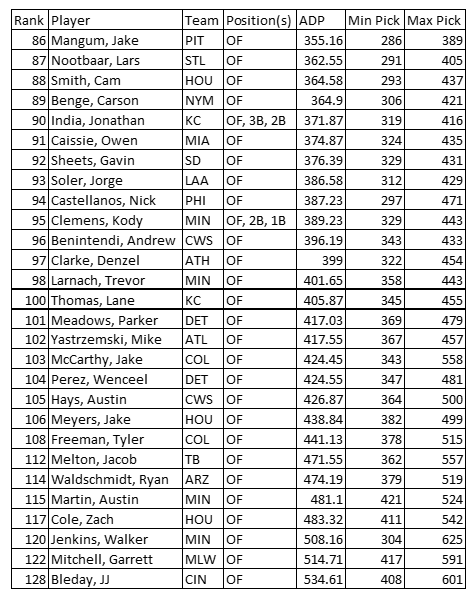
Trevor Larnach has not hit LHP at all in MLB, and he barely got the chance to try to last year, and nobody is, or should be, taking Larnach over Colten Cowser. But especially in an NFBC 50-round draft and hold, with Monday and Friday lineup changes for hitters, Larnach seems overlooked right now, and is a bargain at his current ADP (around 350).  As perhaps a fairer comparison, Larnach’s role is identical to Alec Burleson’s for STL, with Burleson going around 140 picks earlier (based on sprint speed and career norms, Burleson’s 9 SBs in 2024 seem to be a mirage, btw). Burleson is a better bet for batting average (0.272 Steamer Projection), but the adjustments Larnach made last year mostly stick, he should easily beat his 0.242 BA Steamer projection.

As for Cowser, his playing time seems locked in, but is it, and should it be? He’s four years younger than Larnach, so maybe he improves versus LHP. And the Orioles seem to like his LF defense, so that does help. But his platoon splits aren’t great (about 10% worse than the average MLB LHH) (and were even more extreme in MiLB, despite his versus-LHP OBP being buoyed by his insane MiLB walk rates):

MLB SplitsPAABHRBBSOBAOBPSLGOPS
vs RHP48341919551410.2320.3270.4300.757
vs LHP155141510530.2200.2840.3690.653
MiLB SplitsPAABHRBBSOBAOBPSLGOPS
vs RHP900730331482190.3120.4390.5370.976
vs LHP274223535850.2510.3790.3720.751

It is well known that 155 MLB PAs is not enough sample to know how Cowser’s platoon splits will progress, and he could improve versus LHP (and should, at least a minor amount, as regression toward league average would help him slightly). But there is no basis to expect a large improvement.

Is there some platoon-related playing time risk for Cowser despite his prospect status and his assumed plus defense (btw, it seems most metrics peg him as closer to average rather than plus). With the Orioles’ crowded roster, the risk seems non-trivial to me. Especially given that you know who does not seem to have much trouble with LHP? Heston Kjerstad.

Splits (Total, MiLB + MLB)PAABHRBBSOBAOBPSLGOPS
vs RHP70260334731560.2950.3760.5410.917
vs LHP268236916550.2920.3580.4870.845
Heston Kjerstad Platoon Splits

Just 17 of Kjerstad’s 268 vs-LHP PAs have occurred in MLB. Only 12% of his MLB PAs have been versus LHP, whereas Cowser has been given the opportunity to have 24% of his MLB PAs be versus LHP. This, despite Kjerstad’s having produced far better than Cowser versus LHP in MiLB (whatever the surface metric one chooses e.g., batting average, contact ability, and ISO slugging).

I don’t expect it, but it would not be shocking if Kjerstad is getting more ABs than Cowser by the end of the 2025 season.

The takeaways:

  1. Cowser is no sure thing for full-time ABs, and great improvement versus LHP should not be expected.
  2. Kjerstad is a worthy pick at his ADP (about 340), with the potential for nearly full-time ABs even if the Orioles don’t trade him or Cowser.
  3. Despite his certain platoon status, draft Trevor Larnach in NFBC 15-team formats and all deep draft-and-holds, and as an early reserve round OF in 12-team FAAB leagues.
  4. (Bonus) Check out Tyler O’Neill’s 2024 splits versus RHP. Yikes. One-year splits are not worth that much, but until the Orioles trade some of their Lefthanded-hitting depth, I am fading Tyler O’Neill (ADP ~180). In addition to his long injury history, the Orioles may have better options versus righthanded pitching.

2024 Bargain Bat: Max Kepler

Max Kepler is going outside the top 250 in NFBC average draft position (over the past 30 days his ADP is 284 in NFBC Draft Champions drafts). I’d consider taking him 100 spots earlier. Kepler started slowly in 2023, but he was one of MLB’s best hitters from late June on, and he ended up with a career-best 12.2%-barrel rate, while maintaining an acceptable 21.6% K-rate. Despite still decent speed (27.4 ft/sec (52nd percentile)) he won’t steal bases (1 SB last year), but he should provide four-category production (well, let’s hedge a bit on batting average and say 3.5-category production) for 2024. 

Kepler has had two years with a WRC+ greater than 120, his 36-HR 2019 (122) and 2023 (124). He was good in the shortened 2020 season (109 WRC+), bad in 2021 (97 WRC+) and even worse in 2022 (95 WRC+), when despite his lowering his already good K% to 15%, his groundball rate ballooned to 46% while his HR/FB rate fell to 8% – frankly, he looked done in 2022, or at least completely out of whack. What made his 2023 production more like (much, much more like) his 2019 rather than his 2020-2022?

In 2022 Kepler’s production on fly balls was bad. Very bad. Out of 351 players with at least 50 batted ball events, his 55 WRC+ was 291st (17th percentile). In 2023: his 176 WRC+ was in the 68th percentile out of 361 players with 50 batted ball events. Of note, number one on that list? Kepler’s teammate, Edouard Julien, at an insane 501 WRC+… now, that is both unsustainable, and something that needs to be examined further, some other time.

While 68th percentile on flyball production is not elite, it is very good, with cohorts like Mookie Betts and Eloy Jimenez. As an aside, Kepler also flip-flopped his production on groundballs, from the 32nd percentile in 2022 to the 81st percentile in 2023. So, he was better, much better, all-around, on contact in 2023. He was locked in, for much of the year (his OPS from June 20 through the end of the year was .913). From just my anecdotal observation, he was swinging harder and with more purpose than in 2022. Aside from just swinging with greater intent, Kepler’s process was notably different in 2023, as he was more aggressive in the zone (increasing his zone swing rate from 71.7% (basically average) to 74.3% (somewhat aggressive)), and far more successful, despite his walk rate dropping from 11% to 9.2% and his K% increasing from 14.8 to 21.6 (the highest strikeout rate of his career, and his lowest walk rate since 2017).

Searching Baseball Savant, when Kepler put a middle-middle pitch in play in 2022, it resulted in a .200 wOBA, versus a wOBA of .391 on such pitches in 2023. And while he was somewhat unlucky in 2022 (his middle-middle xwOBA was .323) his 2023 results were backed up by the underlying metrics (xwOBA: .432, launch angle increase from 10.5 degrees to 16.4 degrees, and average exit velocity increase from 93 mph to 96 mph).

Overall, Kepler’s increased in-zone swing rate was mostly on inside pitches (4% greater swing rate in 2023) (with similar results in 2023 versus 2022, but much better underlying metrics in 2023); on middle-middle pitches Kepler swung at around the same rate; but he was pitched more often middle (excluding middle-middle) and away (3% more often in 2023), but swung less often on such pitches (70.4% in 2023 versus 73.9% in 2022), and had better results (.388 wOBA in 2023 versus .281 wOBA in 2022).

The tradeoff for Kepler’s change in swing decisions was his taking more pitches away for strikes (15 in-zone away pitches taken for Ks in 2023, versus 7 in 2022), and the tradeoff for his swinging harder was more swinging strikeouts (41 in 446 plate appearances in 2022 and 75 in 491 plate appearances in 2023, a 48% increase in his in-zone swinging K-rate, and a 78% increase in his out-of-zone swinging K-rate).

In 2023 Kepler was off to a decent start, prior to injuring his hamstring and going on the injured list on May 13 (a .232 ISO, with a .206 BABIP dragging down his overall line). He returned from the IL, without a minor league rehab assignment, on May 29 and proceeded with a .143 / .177 /.204 triple slash line over his next 51 plate appearances, leaving him with a .189 / .261 / .365 triple slash prior to his .913 OPS from June 20 on. One probably shouldn’t project him for a .900 OPS, or his .290 batting average through that hot end of season phase, but that is what he did over his final 326 plate appearances.

If Kepler stays healthy and maintains acceptable production versus lefthanded pitchers, he should hit in the middle of the Twins lineup and start most games, even versus most lefthanders – a 30-HR, 90-Run and 90-RBI season is a possibility. Projection systems are going to bake in Kepler’s bad 2021 and horrible 2022. Fangraphs Depth Charts projects him for 573 PAs, but just 24 HR with 72 Runs and 76 RBIs (and a .250 BA). I will take the over on the BA right now, and if he stays healthy and gets those 573 PAs, I think he easily surpasses both the Runs and RBIs. He is definitely a top pick for someone going outside the top 250 who could produce top 100 value.

Drew Waters: How Was He Good in 2022, and Can He Be Better in 2023?

In a recent 15-team draft-and-hold draft, I was picking at the end of round 35 and in need of a reserve outfielder. Drew Waters was still on the board at well past his ADP, and he seemed the most likely to have the opportunity for playing time, so I said, “welcome to the team, pick 525”.

Prior to the 2022-2023 offseason, my knowledge of Drew Waters boiled down to: 1. Good prospect (formerly top 100) and 2. Has plateaued due to strikeout issues. I also recalled that he got a callup in 2022, and was good, but his K% was bad. I didn’t pick him up in any leagues last year, and I don’t recall if I ever did any real digging into his underlying performance. Was he good in 2022? Yes. The “why” or “how” is a bit harder to figure out, especially regarding his 2022 season’s pertinence to predicting his 2023 performance.

I am outsourcing the basic summary of Waters’ 2022 to Rotowire (2023 Fanatsy Outlook on Waters’ player page): “Something clicked after the change of scenery (traded from Atlanta to KC), as Waters hit .295/.399/.541 with seven home runs and 13 steals in 31 games for the Royals’ Triple-A affiliate while almost doubling his walk rate (14.0 BB%, up from 7.6%). He got a well-deserved promotion to the majors in late-August and hit .240/.324/.479 with five home runs, an 11.0 BB% and a 36.7 K% in 109 plate appearances…”

I will get to Waters’ batted ball stats in a bit, but the most interesting thing about Waters (as a prospect, and in his first taste of MLB action) is his plate discipline, most basically notable in his K% and BB%.

For his MiLB career, Waters has posted a 27% K% and an 8.3% BB%. For reference, in 2022 for all MLB those rates were 22% and 8.2%. So, overall: average walk rate, and high, but not ridiculous, strikeout rate. But in 143 PAs for AAA Omaha, Waters nearly maintained his K% (29%), while upping his BB% to an elite 14%. Not surprisingly, the plate discipline improvements didn’t fully stick upon his promotion to MLB (11% BB% and 37% K% in 109 PAs). Is there some hope for an improved K% in 2023?

Projection systems are often (always, actually) useful, but in Waters’ case their utility may be limited — do I want to believe Steamer (8.5% BB% and 28.7% K%) or The Bat (7.1% BB% and 31.6% K%)? All else being equal, that 3% K% difference between the two projections, over 600 PAs, adds up to about 1 HR, at least a few Runs+RBI, and 10 points of BA (and, more importantly, an increased likelihood of maintaining playing time). Is there (maybe) a reason to lean more toward Steamer’s 28% K%. Possibly, based both on Waters’ prior performance, as well as some of his underlying plate appearance metrics.

Waters split 2018 between A-ball and A+, with a 5.8 BB% and a 21.1 K%. Notably, his K% rose from 20% in A-ball to 25% at A+. The Braves pushed Waters to AA to start 2019, and he repeated his K% issues upon his promotion to AAA at age 20 later that year (a 6.8% BB% and a 28.6% K% overall, but his K% rose from 27% in AA (454 PAs) to 36% at AAA (119 PAs)).

Waters’ 2020 was spent at Atlanta’s alternate site, and there is an August 2020 MLB.com article detailing Waters’ awareness of his strikeout issues, in which he stated: “I’m working on learning how to hit with a two-strike approach, just to cut down on some of the K’s.” Did he succeed? Maybe. His 2012 10% BB% and 31% K% does not exactly scream “success!!”, especially given a year at the alternate site to work on things, but it certainly is an improvement from 9% and 36% in his first go at AAA in 2019.

Then 2022 rolled around, and the prospect world had soured on Waters: a consensus top 50 prospect in 2020 and 2021, prior to 2022 Fangraphs had lowered his projected future value to 40+ and labeled him a likely 5th outfielder. To begin AAA in 2022, he lowered his K% to 27% (but with a pedestrian 7.6% BB%) coupled with lower power and BABIP; his resultant 210 PAs of a .697 OPS and .147 ISO likely had further tanked his perceived value. Then… he was traded to the Royals, and he vastly improved his plate skills (as noted above) and his batted ball results.

I think there should be optimism for Waters maintaining, or even improving, his performance in 2023, partially based on narrative, and partially based on Waters underlying plate discipline stats. First, the narrative: Waters has shown improvement (at least of a sort) each time he has repeated a level. His needing to repeat levels may cap his upside at something below a star player, but it shows that he has been able to put in the needed work to get better and make adjustments. Even in his sub-par 2022 stint with AAA Gwinnett, he did at least get his K% back to his career norm (at the expense of power and BB%; but let’s go with the narrative). And then upon the trade to KC, he flourished at AAA Omaha (and carried much of that success to his first stint in MLB). It may not be a full endorsement for Waters 2023 output, but if his history repeats itself, he will keep adjusting and will improve with more PAs at the MLB level. Also feeding this narrative is that Waters is a switch hitter. It is more anecdotal than proven (I think), but it seems that switch hitters do often take longer to fully develop; it shouldn’t be too surprising that Waters needed a bit more time, and a change of scenery to another organization, for things to click for him last year.

Circling back to Waters’ troubling K% in 2022. He is unlikely to strikeout at a 36% rate again. As mentioned, projections have him in the range of 28%-31%. The most basic analysis: Waters’ 2022 K% seems a small sample fluke and regressing the rate toward league norms and toward Waters’ MiLB rates makes sense. But there is hope for further improvement once one dives a little deeper into Waters’ underlying plate discipline as well.

Waters’ 71.3% contact rate is below average (he ranked 390th out of 498 players with 110 PAs or more), but it won’t be contact rate in and of itself that holds him back (Julio Rodriguez and Jazz Chisholm both had slightly lower contact rates). Overall, his plate discipline metrics were also close to Tyler O’Neil, Dansby Swanson, … long story short: his overall plate discipline skills are solid enough, despite his above average swing-and-miss. And upon digging into some of Waters’ performance in certain counts it became apparent that Waters’ elevated K% probably had as much to do with some mid-count over aggressiveness, and late count passivity, which will likely even out with greater sample size and some in-season approach adjustments.

A quick look at his batted ball results also offers reasons for optimism. Analyzing his batted ball rates is based on only 57 batted ball events, so I feel safe in throwing out his 84-mph average exit velocity and instead rely on his 12% barrel rate and his 111-mph max EV to indicate that his quality of contact should stay above average. 11 of Waters’ 57 batted ball events exceeded 99 mph EV (with the lowest launch angle being 6 degrees); when Waters connects, his contact is dangerous. His 26% HR/FB rate isn’t likely to fully hold (but he also had a 28% rate at AAA Omaha), and his 48% groundball rate is higher than ideal. His 10% average launch angle is a bit low, but in the small sample, swapping a couple groundballs for flyballs would have that at 15%.

Waters has playing time competition in KC, so if he flounders, he will lose at bats, and possibly end up back at AAA. He also did not steal a base in 32 MLB games, but in MiLB he averaged 25 SB per 600 PAs. Waters has 20 HR and 20 SB potential, and with a recent NFBC ADP of 441 (30th round of a 15-team draft and hold) he is certainly worth the pick at any point in the reserve rounds of a 15-team draft.

I Hate the Mitch Garver Trade

As a Twins fan, I love Mitch Garver, and I hate the Mitch Garver trade to the Texas Rangers for Isaiah Kiner-Falefa (and MiLB RHP Ronny Henriquez), but I (maybe) see how it makes sense for the team, especially if they have faith in Ryan Jeffers’ taking a step forward with the bat in 2022. 

First, here is something I wrote about Garver about six weeks ago: 

  • He, if healthy all year, could be a top 100 player (and is especially worth the risk of a top 10 round pick in any deep draft and hold format).  Yes, he was horrible in 2020.  He has been hurt.  A lot.  He is already 31 years old.  He was very good in 2021 but he did strike out a bit last year despite his overall impressive numbers.  I get all that, and I get that projection systems need to bake all that history and risk in.  But he is a catcher with a career 122 WRC+ and a .238 isolated slugging percentage (setting a minimum of 1000 PAs, his WRC+ is 55th among all hitters since 2017).  Going back to his debut, he is a better hitter than Salvador Perez (and it isn’t particularly close).  If we limit things to 2019-2021, there is a clear top four at the catcher position based on WRC+ (Will Smith and Garver at 135, Perez at 134, and Yasmani Grandal at 132, with a chasm between them and the next group starting at 115 WRC+).  Perez is a beast, and will play every day, so I am not arguing that Garver is a better fantasy option in the year 2022.  But Garver is really, really good, and it would not shock me if he were the best catcher in fantasy on a per game basis this year.

So, yeah, I like Garver a lot.  Garver’s career WRC+ is 122. Jeffers’ is 88.  The odds of Jeffers’ being a better hitter than Garver in 2022 are really, really low.  But the Twins love Jeffers’ defense, and they think he is potentially at least a league average bat.  Catchers have a reputation for often taking a long time to fully develop has hitters, and Jeffers has less than 1200 total professional plate appearances (the equivalent of about two full-time MLB seasons), and just 557 PAs above A-ball (including his 355 MLB PAs).  Projection systems have him as about 10% worse than league average in 2022, so he could reasonably hold his own at the plate, with (hopefully) further development once he gets another season or two under his belt. 

Regarding the fantasy baseball perspective, how does this trade impact the Twins lineup?  Actually, not much, in my opinion.  It is a boon for Jeffers, of course, but the other impacts are negligible (maybe a very minor overall downgrade to all Twins players as well?).  Unless one was counting on a lot of playing time for Nick Gordon, the ripple effect is just not that big.  The Twins were always planning on bringing in a shortstop, via free agency or trade, and had no intention of starting Jorge Polanco at SS (and were never going to give significant PAs to Gordon there either).  So, beyond raising Jeffers’ starts from about 70 to about 120 (which is huuuge), there isn’t really much to analyze – maybe there will be a bump in expected PAs for Jose Miranda, as having Garver out of the picture opens up a bit more playing time at DH, but not much else.

For the Rangers, they suddenly really, really need a third baseman with Kiner-Falefa gone and Josh Jung likely out for the entire season.  But the trade also means an upgrade for all Texas hitters, as Garver projects much better than their previous tandem of Jonah Heim (projected WRC+ of about 85) and Jose Trevino (about a 70 WRC+), and whatever third baseman they get will likely be a better hitter than Kiner-Falefa.  Update: Andy Ibañez still exists. I did (sort of) remember that. Is he more than a lefty masher (maybe we’ll see)?

And what about Jonah Heim? I was pretty big on Heim for this year… Speaking of catchers taking some extra time to develop; he has just over 800 PAs at higher than A-ball, so there is plenty of time to see if his bat improves, especially since he is a switch hitter.  And he has had an amazing trend of vast improvement once he repeats a level:  A-ball: 74 WRC+ for first 157 PAs, 112 WRC+ for last 321 PAs; High A: 75 WRC+ for first 437 PAs, 113 WRC+ for last 348 PAs; AA: 29!!!!! WRC+ for first 154 PAs; 125 for last 208 PAS (followed by WRC+ of 135 in 119 AAA PAs in the same season).  The dude has potential, but this trade likely tanks Heim’s fantasy value for 2022, barring another trade, or unless the Rangers slot Garver in as the primary DH versus LHP and therefore still get Heim about half-time PAs.  This seems unlikely, as the Rangers had ten players get at least five DH starts last year; but if Heim hits, at least there is still the possibility he gets 300+ PAs.

Circling back to the Twins to wrap this up. The Twins would project a couple wins better for 2022 if they had swung a deal using some of their abundant MiLB pitching depth for a shortstop, or through signing a free agent, and hanging on to both Garver and Jeffers. Mitch Garver (when healthy) is great; he was maybe the second-best hitter on the team, so for a Twins fan, this trade is a tough pill to swallow.  But Jeffers is only 25, and Garver is 31.  Kiner-Falefa is only 27 and has the same amount of team control as Garver; the Twins also received Ronny Henriquez, who seems like maybe a top 200 prospect (Fangraphs has slotted him in as #9 in the Twins system, with a 45 future value).  And Kiner-Falefa’s positional versatility will allow him to slide to third base if the Twins trade Josh Donaldson and bring up Royce Lewis this year or next; or he could be a functional utility piece for them.  I wouldn’t have made the trade, but it does make some sense.  I hope.

Drafting Vlad: a (Very) Small Case Study

Vladimir Guerrero was the top-ranked roto player in 2021.  Thus far in NFBC Draft Champion (DC) drafts (15-team, 50-round draft and hold format, with an overall contest in addition to league prizes) his average draft position (ADP) rank is pick 7 (ADP 6.56) (after Trea Turner, Fernando Tatis Jr., Jose Ramirez, Juan Soto, Bo Bichette, and Gerrit Cole (ADP 6.51)). It is a marginal change, but he is trending down, I that his ADP was ahead of Cole’s in DC drafts dated up through 2/18/2022.  In drafts dated prior to 1/1/22 Vlad’s ADP was 6.10 and Cole’s was 7.88; since 1/1/22 Vlad’s ADP has been 6.80 (Cole: 5.81), and since 2/1/11 Vlad’s has been 7.29 which is much closer to Corbin Burnes’ ADP (8.00) than Cole’s during that span (5.17). 

So why is last year’s #1 player going outside the top 6 picks, and trending (slightly) downward?  Breaking no news here: it his Vlad’s lack of stolen bases.  The ATC projection for Vlad’s SBs is 3.  For the five hitters going prior to Vlad in DC drafts their average projection is 23 SBs (Soto projects for 11, but also for an even better wOBA than Vlad; removing Soto from the mix, the other four players project for an average of 26 SBs).

And it isn’t just the hitters taken before Vlad. Out of top 25 hitters in February DC ADP, only two are projected for fewer SBs than Vlad: Yordan Alvarez (1 SB, 31.63 ADP) and Salvador Perez (1 SB, 38.51 ADP). Outside of Alvarez and Perez, just three other of the top 25 hitters are projected for fewer than 10 SBs (Mike Trout, Freddie Freeman, and Rafael Devers).  The average SB projection for the 19 hitters after Vlad in ADP is 16 SBs. One can slice this any number of ways, but the simple point is that at the top of the draft SBs are at a premium.  They are at such a premium, there has been some chatter in the fantasy baseball community regarding whether it is worth it to draft Vlad in the first round.  Time will tell regarding that, but what can be examined right now is how folks have been building teams with Vlad as their #1 pick.

This draft season I have been in three DCs and three NFBC 50s (50 round draft and hold, but 12 teams, and with the overall contest far less pertinent than the league prizes).  Let’s take a look at the first ten rounds for the Vlad teams in the three DC drafts, to see how each fantasy manager addressed SBs (and pitching) (I will cover the NFBC 50s in the next post).

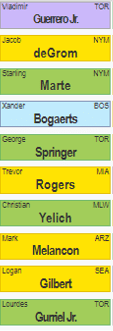
DC 1: I had pick 11, so I did not have a shot at Vlad (pick 7). The Vlad drafter came back with SP Brandon Woodruff in round two, got their SB base with Cedric Mullins in round three, 10 or so SBs from the catcher position in round four with Realmuto, and another 10+ SBs from India in round 6. Maybe a few chip-in SBs from Springer, and likely negligible SBs from Correa. Backing up Woodruff, they filled out their SP 2-4 with some nice upside SPs. A pretty good build that could get close to 10 SBs per hitter, and a nice SP rotation. The downside: zero closers — they did grab their first two closers in rounds 12 (Scott Barlow) and 14 (Matt Barnes); both have their appeal, but neither is a sure thing as a locked-in closer.

DC 2: I had pick 8, and so I missed out on Vlad, who again went at pick 7. The Vlad drafter came back with SP Jacob deGrom in round two, got their SB base with Starling Marte in round three, 5-10 chip-in SBs from Bogaerts and maybe a few from Maybe a few from Springer, and 12-15 from Yelich. And zero or so from Lourdes Gurriel. Backing up deGrom with young upside: Trevor Rogers as their SP and Logan Gilbert as SP3. They grabbed Malancon as their top RP in round 8 to lock down what should be a safe 25 Saves. The hitters again could get close to 10 SBs per spot, and while the SPs have upside there is a fair amount of risk. Seems a bit of a boom or bust approach

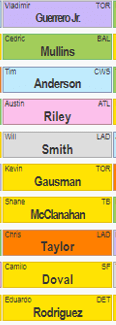
DC 3: I had pick 6, so I decided to pick Vlad (not knowing if I’d get another good chance to get him anywhere). I got my 27-SB base with Cedric Mullins in round 2, and then Tim Anderson was still there at pick 36, so I decided to add his 19 SBs and well-rounded line to my team. I then followed that up with power bats Austin Riley and Will Smith. No pitchers to this point, and it obviously impacted the rest of my draft. For the Anderson pick, I passed on Freddy Peralta, Lucas Giolito, Robby Ray, and second-tier closers. For the Riley pick, I passed on Chris Sale, Max Fried, and Lance Lynn. For the Smith pick, I passed on Joe Musgrove, Jack Flaherty, Dylan Cease, Logan Webb, Frankie Montas, and Jose Berrios… yikes. I sort of regret passing on Fried, but with the next pick, I was pretty sure I’d be ok with the SP that made it back to me; and the last one in that tier for me did (Gausman), so that worked out. In hindsight, I am not in love with the McClanahan pick, but all my true targets in that range were gone (four SPs and three RPS went in the ten picks between Gausman and McClanahan). After that, I felt good about my batting average at that point, so I went with the versatile 10-15 SB Chris Taylor in round 8. After passing on Melancon, Corey Knebel, and Craig Kimbel in round 8, all the sure-thing closers were gone by round 9 (and that is an iffy label for Knebel and Kimbrel anyway), so I got my one share of Camilo Doval in round 9 (I handcuffed him with Jake McGee in round 17 and Tyler Rogers in round 41). And in round ten I went with Eduardo Rodriguez to shore up my suspect SP roster to that point (I also got my one share of Ranger Suarez in round 11). I should average a bit over ten SBs per spot for my top six hitters, and my power and batting average should be above average. The obvious downside to this team is its lack of ace SPs and my rolling the dice on RPs; but I did draft 14 SP total, so if my top three SPs do come through (and if I can get 30+ saves elsewhere in addition to my hopefully covering the SF bullpen), this team should do pretty well.

Each of these three Vlad drafts have some positives and some negatives.  The first kept pace with needed SBs and has great SP upside (with some risk), but no locked-in saves.  The second again did ok with SBs but seemed to really lean into high risk/reward, despite locking in 25 saves with Melancon.  The third (my Vlad draft) ended up with the most assured SBs, as well as solid hitting overall, but I was somewhat gambling on my hitting on a few middle and late SP and RP targets. 

Overall, in this very small set of three DCs, I don’t get the sense that any of the three Vlad drafters were hamstrung by Vlad’s lack of SBs.  Each drafter seemed aware of the need to get their SBs, and at least kept up with a reasonable target for SBs, but none of the three strategies appear overly impacted by SB scarcity.

Alex Kirilloff: 2021 Barrel-direction outlier, and 2022 breakout?

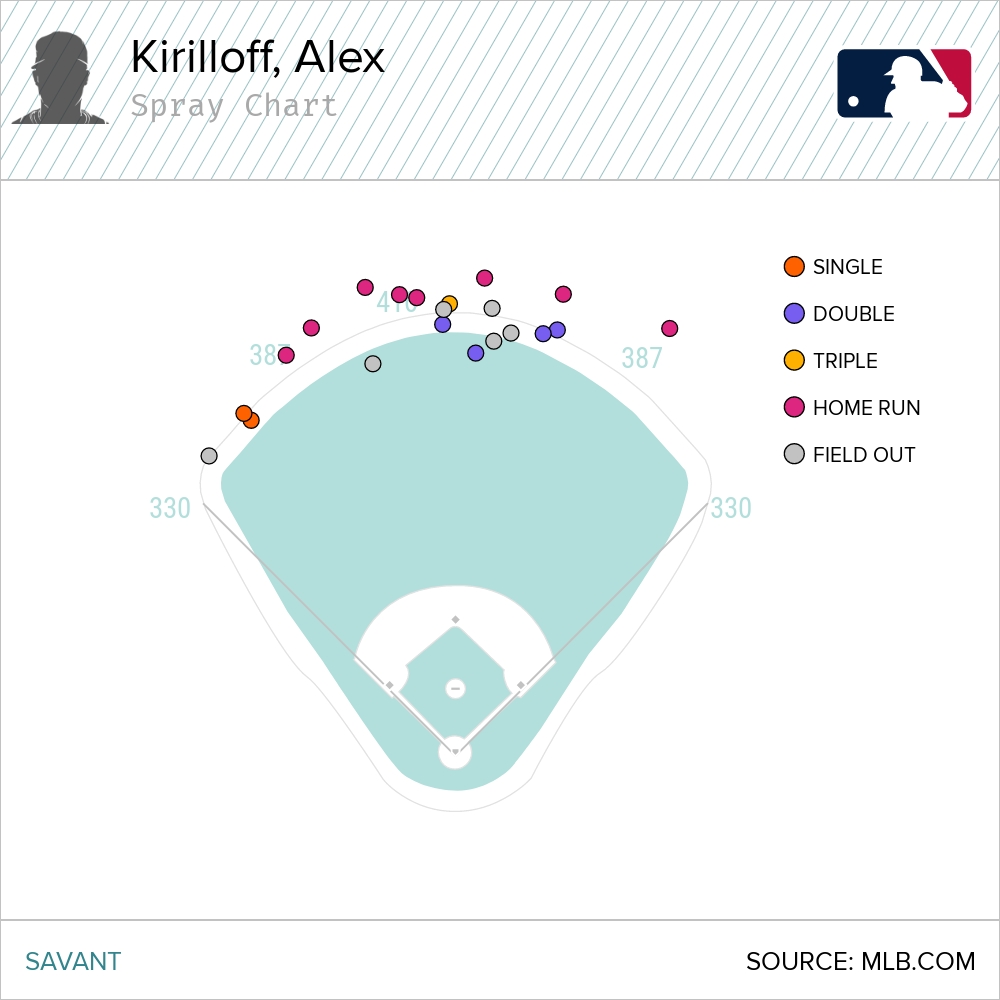
In Alex Kirilloff’s injury-shortened 2021 season, he barreled 21 batted balls.  None of those 21 were extremely pulled: one went to straight-away rightfield, and the rest were oppo or right-center to left-center.  In a full season of at bats, odds are Kirilloff yanks a few more barrels to rightfield, but in his 200+ AB 2021, the extremity of his barrel-producing up-the-middle approach stands out.

Statcast delineates straight-away CF as the zero-degree horizontal launch direction, with hits to the left of center having a negative horizontal launch direction and hits to the right of center having a positive horizontal launch direction.  Kirilloff had one barrel in 2021 with a horizontal launch direction of greater than 10 degrees (a 431-foot shot pulled 19 degrees to the right of center).    

How unique was Kirilloff’s barreled-ball horizontal launch angle?  On a pitch% basis, his rate for 10 degrees or less horizontal launch angle barrels was 2.4% (i.e., 2.4 barrels between the left field line and 10 degrees right of CF per 100 pitches). The next closest batter was Rafael Devers at 1.7%.  Maybe the LHH I most associate with oppo/CF power is Yordan Alvarez.  Alvarez is pretty close behind Devers, with a rate of 1.5%.  Kirilloff’s rate was more than 50% greater than Alvarez’s and more than 40% greater than Devers’.

The MLB average for LHH batters in 2021 was 0.57%.  Kirilloff’s rate was more than four times the average rate for LHHs.  Limiting the sample to the batters that had at least five barrels of 10 degrees horizontal launch angle or less, Kirilloff’s rate was nearly five standard deviations greater than the non-weighted average rate for those players (Devers’ rate was only about three SDs greater).

Is this interesting?  Does it matter?  Maybe.

Sticking to the three young guys mentioned above (Kirilloff is just a year younger than the other two), what sets Alvarez and Devers apart from Kirilloff?  Kirilloff walks a bit less, but all three struck out at about the same rate in 2021, so plate discipline is probably not a driving factor.

In addition to Kirilloff’s not pulling hard-hit balls in the air, the primary reason his production trailed the others was his propensity for hitting groundballs in general, and his hitting groundballs when he pulls the ball in particular.  Kirilloff’s average exit velocity and max EV lagged his counterparts as well.

PulledPulled
NameEVmaxEVLAGB%GB%FB+LD%Barrel%
Rafael Devers92.9114.413.141.2%53.0%47.0%15.0%
Yordan Alvarez93.2116.414.137.8%58.3%41.7%15.9%
Alex Kirilloff91.0108.47.048.8%70.0%30.0%12.8%
Kirlloff’s 2021 Barrels

Kirilloff injured his wrist in May 2021 and played through the injury for two months prior to getting season-ending surgery in July.  While Kirilliff often also had moderately high groundball rates in the minors, it is possible that his wrsit injury contributed to his low average launch angle and high groundball rate in 2021 (and injuries in the minors also impacted his performance, and likely his MiLB GB rate). 

Even with the wrist injury and the high rate of groundballs, Kirilloff’s barrel rate was still nearly elite.  Kirilloff has the power to exceed 30 HR per season, but his up-the-middle results on flyballs/line drives somewhat limited him in 2021, and his groundball rate severely limited him.

If Kirilloff’s wrist is healthy, he may increase his average EV in 2022, but more importantly he hopefully will be able to make the adjustments necessary to get more lift to the pull side, up his average launch angle into the mid-teens, and lower his rate of pulled groundballs.  If he does that, he will likely retain his all-fields power, but will no longer be a complete outlier with 95% of his barrels going to right-center through leftfield; and he may be a viable fantasy and real-world breakout in 2022.

Mr. ADP 361, Evan Longoria

Let’s look at the MLB top ten third basemen for 2021, minimum 250 plate appearances. Included in the table is the NFBC Draft Champions ADP for the most recent 30 days (40 DC drafts).

 ADPGPAHRRRBISBBB%K%ISOBABIPAVGOBPSLGwRC+
13.75152636361111032711.30%13.70%0.2720.2560.2660.3550.538137
265160662339110707.90%25.40%0.2270.3680.3030.3670.531135
3181566643810111359.30%21.50%0.2590.3070.2790.3520.538134
4176151612278787310.00%16.00%0.1930.2920.2780.3610.471127
5210135543267372013.60%21.00%0.2280.2680.2470.3520.475124
61011445862586731010.60%23.00%0.2160.3130.2650.3530.481123
736181291134546112.00%23.40%0.2210.3050.2610.3510.482123
8153144616147461313.60%25.50%0.1480.350.2630.3750.412122
9231536402892106129.80%15.90%0.2110.290.2780.3470.489122
10207149626167567010.40%21.60%0.1720.3330.2710.3510.443119
2021 MLB 3B, sorted by WRC+ (min 250 PAs)

What is clear at a first glance is the importance of SBs. I am not revealing a big secret by naming Jose Ramirez as the first 3B off the board, with an ADP of 3 or 4. At ADP 23 we have Manny Machado, whose SBs and low K rate, along with elite Statcast numbers, keep him solidly in the top 2 rounds of 15-team fantasy drafts. Y’all also love Rafael Devers with an ADP of 18. Thirty-eight HR and elite Statcast data justify his spot, if one is willing to take just a likely handful of SBs. After Machado and Devers there is the special case of Adalberto Mondesi at ADP 57 prior to the next guy on the list: Austin Riley at ADP 65. He is Rafael Devers, but with zero SBs and a higher K rate; I think I take Riley ten times out of ten if I could pass on Devers and guarantee getting Riley. I could keep naming guys, but let’s dispense with that and just summarize the listed and non-listed guys with stating that 3B gets kind of mushy after Riley, and if one misses out the top end, then pick your favorite bounce back guy or boring veteran; or roll the dice on a young guy. So here is the table, with names, and a longer look at Mr. ADP 361, Evan Longoria.

 ADPGPAHRRRBISBBB%K%ISOBABIPAVGOBPSLGwRC+
Jose Ramirez3.75152636361111032711.30%13.70%0.2720.2560.2660.3550.538137
Austin Riley65160662339110707.90%25.40%0.2270.3680.3030.3670.531135
Rafael Devers181566643810111359.30%21.50%0.2590.3070.2790.3520.538134
Justin Turner176151612278787310.00%16.00%0.1930.2920.2780.3610.471127
Josh Donaldson210135543267372013.60%21.00%0.2280.2680.2470.3520.475124
Kris Bryant1011445862586731010.60%23.00%0.2160.3130.2650.3530.481123
Evan Longoria36181291134546112.00%23.40%0.2210.3050.2610.3510.482123
Yoan Moncada153144616147461313.60%25.50%0.1480.350.2630.3750.412122
Manny Machado231536402892106129.80%15.90%0.2110.290.2780.3470.489122
Jeimer Candelario207149626167567010.40%21.60%0.1720.3330.2710.3510.443119
2021 MLB 3B, sorted by WRC+ (min 250 PAs)

First off, Justin Turner? He’s still good. As is Josh Donaldson. Also good, and seemingly a statistical doppelganger for his erstwhile teammate Kris Bryant is Evan Longoria. Bryant is young(-ish) and should steal a few bags, plus has OF eligibility, so his ADP is more or less appropriate (opinions will differ, but he is in the right ballpark). But why are eternal injury risks Turner and Donaldson going 150 to 200 picks ahead of Longoria? The short version of the answer: projection systems hate Longoria. But should they, and how much does that matter (even if they should)?


The Steamer 600 projections at Fangraphs spits out a .273 (BA) / 23 (HR) / 79 (R) / 84 (RBI) line for Turner (122 WRC+); Donaldson: .249 / 29 / 86 / 83 (128 WRC+); Longoria: .247 / 23 / 70 / 77 (107 WRC+). Steamer projects repeat performances for JT and JD, and a regression to 2017-2021 production for Longo. Longoria last surpassed a 120 WRC+ in 2017 (123), and projection systems take that into account (I don’t know how far back any projection systems take into account, but 2017 was Longoria’s only WRC+ greater than 109 since 2013.)
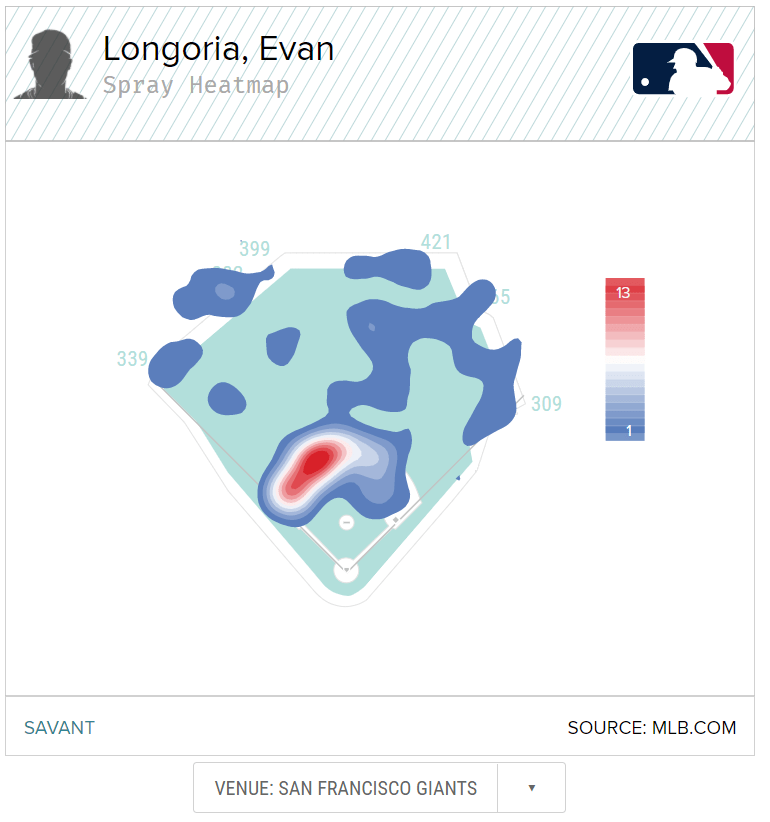
But Longoria was a different, better, hitter last year than in his other recent past: second-best walk rate of his career, and a career-low chase rate (22.5% OSwing). His called strikes plus wiffs (CSW%) was in line with his career norms, but without doing the deepest of deep dives, it seems clear that he was swinging at pitches he could punish, and he was mostly succeeding (he had easily his highest average exit velocity (94.1 mph) and max EV (113.2) of the Statcast era. Setting the minimum number of batted ball events to include Longoria and he is tied with Donaldson for fourth in MLB for average EV. For flyball/line drive EV he was “only” 26th. Whatever adjustments he and the Giants made prior to 2021, they worked.


The argument against picking Longoria much earlier? The mediocrity of 2018-2020? We can’t erase that – but again: he wasn’t that hitter last year, so how much should expectations be regressed to his recent norms? He’s injury prone? Not particularly, and certainly no more so than Donaldson and Turner (Longoria’s big chunk of missed time in 2021 (58 games) was due to a fluke injury – a collision with Brandon Crawford) (he also missed about two weeks with a “sore hand” – a bit nebulous, and troubling). His injury risk is probably average for a 36-year-old. Playing time? Sure, the Giants will Giant (mix and match / platoon), but in 2021 he played in 81 of the available 91 games that he wasn’t on the IL (he started just 67), but that was without the benefit of the DH in the National League. His expected playing time seems a pretty good match for Donaldson or Turner, but projection systems all project more than 100 more PAs for JD and JT. Basically, I don’t get it.

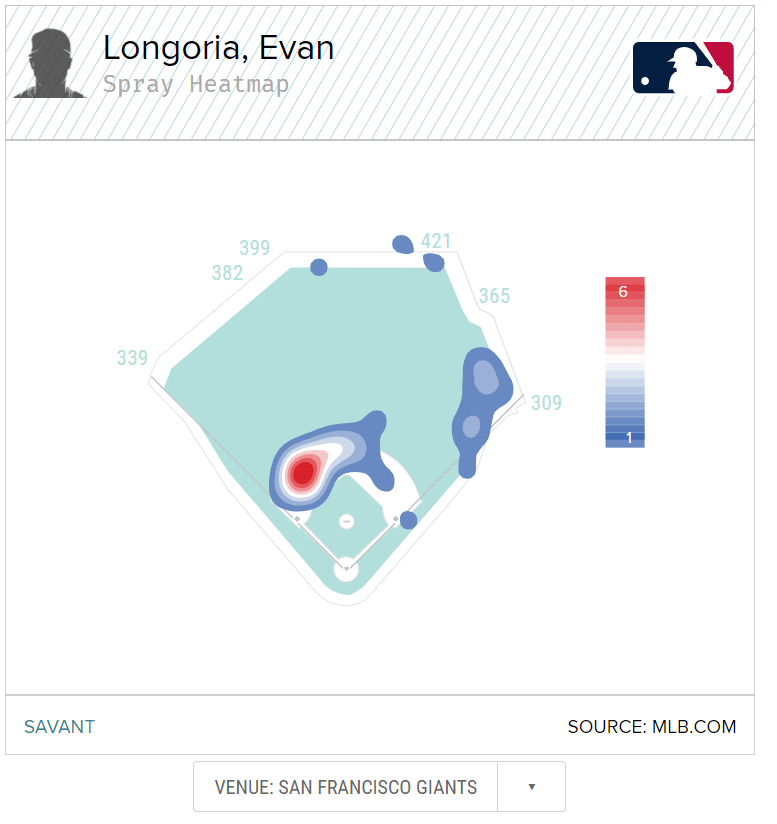
And there may be one more reason to bump Longoria way up your draft board. Through September 16th he had .296 BA and a .948 OPS. .948!!! He ended the season in an epic slump that brought his BA down to .261 and his OPS down to .833. There was seemingly no injury involved in the slump (maybe the sore hand was still an issue?) – but it was a real, massive, slump, and despite maintaining an average EV of 94 mph, it was mostly deserved: through 9/16, his xwoba was 0.383 and after 9/16: 0.196; and his K rate went from 21% to 36%. Longoria seemed to get more on track by the last couple days of the season, and he looked mostly ok against tough pitching in the NLDS versus the Dodgers (including that massive HR versus Max Scherzer).

We can’t ignore the projections. But in Longoria’s case I think they mostly just point out the risk, and completely ignore the upside. I am not projecting him for 600 PAs, but even with 500-550 PAs he could get to 25 HR and exceed 160 runs+RBI, with a .260 BA.

Good Longoria, through 9/16/2021. All-fields power, and some ground balls up the middle.
Bad Longoria, after 9/16/2021. Weak grounders and a couple oppo fly balls. And some solid liners to center; but no hard contact pulled in the air.

A Young Twins Outfielder Hits the Ball Hard

The Minnesota Twins have a lefty-hitting outfielder that had a pretty good 2021 rookie season with the bat. He only received a bit over 200 at bats, but he showed he could sting the ball, with a Statcast hard hit rate greater than 44%. His maximum exit velocity was not elite, but it exceeded 108 mph and was solidly above average. A groundball rate of around 50% may have held back his overall production in 2021; but he’s still pretty young, so maybe he can lift the ball a bit more often in 2022 and have a breakout season.

I could be writing about Alex Kirilloff. I am, sort of, as those few lines above all describe Kirilloff’s rookie season. But those lines also fit Nick Gordon’s rookie season.

Gordon and Kirilloff had even more in common in 2021. In addition to their high groundball rates, their low-ish walk rates also held back their production (about 6% for each). Especially for guys that don’t walk a ton, each had moderate issues with strikeouts (22.5% for Kirilloff and 25.5% for Gordon – Gordon, swings, chases, and misses a bit more than Kirilloff; at least he did so in 2021).

Getting back to raw power: we are dealing with small samples, but each had 50% of their home runs be of BaseballSavant’s “no doubter” variety (which, with the small sample caveat, is basically average). And each had a maximum exit velocity of 109 mph (well, 108.4 for Kirilloff, but I will bump him up to 109 to keep playing this game).

Barrel rate is where Kirilloff and Gordon diverge: Kiriloff’s was 12.8% (right around Jorge Soler and Matt Olson) and Gordon’s was 6.8% (right around César Hernández and… Nolan Arrenado?) Arrenado had an average launch angle of 20 degrees versus 9 degrees for Gordon, so even though overall his batted ball metrics look worse than Gordon’s in several key ways, I won’t fall down that rabbit hole right now – maybe later, when I get a look at launch angle histograms for each player…

I don’t expect a big power breakout from Nick Gordon in 2022. But he does hit the ball hard enough to have one, and the César Hernández comparison may be apt, at least from a power standpoint (Hernández has always walked more and struck out less than Gordon did last year). It took several years before Hernández started hitting for home run power, and 2021 was his first 20+ HR season.

Moreover, Gordon probably shouldn’t focus too much on jacking the ball out, as he already has chase issues and swing-and-miss issues. If he curtails his swing and miss tendencies a bit, he can still whack the occasional meatball out while still just focusing on good contact. Overall, using the stats over at Fangraphs, his soft contact rate was just 7.5% (medium: 48.6%, and hard: 43.8%).

So where does this put me from a fantasy perspective? I am still in on Kirilloff inside the top 200 picks – that 12.8% barrel rate is too enticing, and he certainly passes the eye test. But I do have a bit more trepidation regarding him as a potential breakout.

And Gordon? In my previous post on the Twins, he was pretty much an afterthought. And I still don’t think the Twins really want to get him much more than 200 plate appearances this year. But if he somehow stumbles into 400+ PAs, with a bit of luck (or selling out a bit more for pull power) he could hit up to 15 HR while maintaining an ok batting average, as well as steal 20 bases, and he is worth a late roll of the dice.

And one parting thought: Gordon is a couple years older, but let’s disregard that and just scout the stat line: he doesn’t look that different from Jazz Chisholm. Gordon is fast and Chisholm is super-fast. Beyond that? Hmmm.

Will the Twins “Rays It Up” in 2022?

A Roundabout Explainer on a top 150 Pick for Mitch Garver. Or: after trading Nelson Cruz to the Rays last year, it makes a bunch of sense for the Twins to try to be a bit more like the Rays this year.

One can only take on so much risk in a draft, but I am getting the feeling that this year I will spend a lot of my “risk capital” in drafts on Mitch Garver.

But first, have you looked at the Minnesota Twins’ projected lineup? (let’s not even start on their pitching rotation…)  They don’t have a shortstop.  RosterResource over at Fangraphs has to put something in there, so they pencil in Jorge Polanco.  If Jorge Polanco starts more than 20 games at shortstop for the Twins in 2022, they will have done an about-face on their plans for the player, or several things will have gone very wrong for the team this year (maybe both).  This is not meant to be a post that picks nits regarding RosterResource – who is one supposed to put at SS, Nick Gordon? Um, no (the Twins showed no signs of considering Gordon as more than a utility option).

But in a roundabout way, taking note of their shortstop situation brings me to the broader issue for the Twins: how does one even attempt to project playing time for any of their non-Byron Buxton, non-Polanco position players?  It is not an enviable task, especially in light of the other major new complication to the Twins lineup: the lack of Nelson Cruz, whose absence frees up the DH spot for… well, for whom?   Ideally, not just one or two players.  The details of the “why” to that would be a whole other post, but I am damn sure that the Twins don’t want Josh Donaldson and Miguel Sano taking up 120 or more DH starts (or even 100). Time will tell, but it is an assumption I am going with.

So, with that introduction, I am going to take some idealized playing time guesses (not real, or meant to be projections, but my best guess of what I would desire if I were running the Twins).

First, dispensing with the shortstop situation: The Twins will sign someone (not Carlos Correa, of course, but maybe Jose Iglesias) (or trade for someone – Nick Ahmed, if Arizona eats most of the money?).  If they don’t, it will be a shock, and if so, from a fantasy perspective, the main impact will just be its possibly leading to marginally more plate appearances for all of the Twins’ primary players (and 2023 SS eligibility for Polanco), and some additional SBs for Gordon in deep leagues.  I am fantasy drafting with total certainty on this… unless we reach mid-March and the Twins still have not picked up a full-time SS from outside their system.

So, here we go, position-by-position, in order of my certainty/desire (barring injury, which is a big caveat for any team, but especially for the Twins with Buxton, Donaldson, and Garver all having extensive injury histories, and the 24-year-old Luis Arraez seemingly having the knees of an aging catcher).  Obviously, this is all just semi-educated guesswork, as an exercise to show how things could ideally work out for the Twins:

  • Center field: Byron Buxton for 150 starts.  Others: 12 starts.
  • 2B: Jorge Polanco for 135 starts.  Luis Arraez for 15.  Jose Miranda for 12.
  • Catcher: 60/40 split for Mitch Garver and Ryan Jeffers (98 starts for Garver and 64 for Jeffers).
  • SS: TBD for 130 starts. In 2020 Andrelton Simmons played in 131 games and started 126.  Polanco for 5.  Gordon for 27.
  • RF: Max Kepler for 130 starts (assuming he is not traded; and he may be the Twin most likely to be traded).  Alex Kiriloff for 25.  Others: 7.
  • LF: Luis Arraez for 84 starts. Alex Kiriloff for 72.  Others: 6.
  • 3B: Josh Donaldson for 100 starts.  Jose Miranda for 47.  Luis Arraez for 15.
  • 1B: Miguel Sano for 95 starts.  Alex Kiriloff for 22.  Jose Miranda for 45.
  • DH: Josh Donaldson and Miguel Sano for 35 starts.  Mitch Garver for 26 starts. Jose Miranda and Alex Kiriloff for 20 starts.  Polanco and Arraez for 10. Others: 6.

So, that leads to:

  • 150 starts: Byron Buxton and Jorge Polanco
  • 139 starts: Alex Kiriloff
  • 135 Starts: Josh Donaldson
  • 130 starts: TBD shortstop, Max Kepler, Miguel Sano
  • 124 Starts: Mitch Garver, Luis Arraez, Jose Miranda
  • 64 starts: Ryan Jeffers
  • 27 starts: Nick Gordon
  • 31 Starts: others.

To repeat: this is idealized spit balling; even if the Twins are theoretically mapping out something like this, the playing time (and starts at each position) will likely end up pretty different from this, and the number of starts for “others” will almost certainly be far greater due to various injuries or under performance.  The exact particulars of my guesswork don’t matter; what matters is how I see the Twins ideally wanting the overall playing time to work out, and how that impacts how I look at projections.

What this back of the envelope exercise further shows is that the Twin have some decent hitting personnel, and that projecting their playing time is probably more art than science. The systems / individuals that do actual projections have their work cut out for them regarding the Twins…

Jose Miranda hasn’t stepped a foot into MLB, but he sure looks like he can hit, and if he does hit then the Twins will get him playing time that beats his current projections. 

Buxton is generally only projected for about 450-500 PAs, but if healthy the Twins would love to get him 650 PAs.  If Buxton gets 150 starts and 650 PAs, he is a first-round talent in roto leagues.  Over the past month his ADP in NFBC Draft Champions leagues is about 60.  Too high or too low?  In a Draft Champions, one should be able to get enough depth at OF to fill in if Buxton goes on the injured list at some point, so the snake draft turn at Round 4 / Round 5 is sensible, but I could totally see him going a round or more earlier… (he went at pick 47 in a DC draft I am in, and his minimum pick over the past month is 44; his maximum pick during that span was at 89 – I wish I had been in that draft).

Donaldson is 36 years old and has a balky calf.  Can a mixture of days off and DH duty keep him mostly healthy and get him to 550+ PAs?  (Projection systems all seem to judge “yes” on that one.)

Speaking of Donaldson, he and Mitch Garver have had basically similar value on a per at bat basis over the past three years. Even including Garver’s epically bad 2020 his three-year WRC+ is 135 versus 128 for Donaldson, but seemingly very few people in the fantasy industry have addressed the concept of Garver getting a significant chunk of the DH at bats in 2022 (Justin Mason has addressed it at least twice, once on the Sleeper and the Bust podcast and once in his ADP Market Report).  Yes, Garver is probably even more of an injury risk, but the Twins should try to get Garver as many PAs as he can reasonably get.

The yearly Miguel Sano pessimism (realism?) is evident online, but did you know that Miguel Sano had an .851 OPS over his last 80 games in 2021?  He is a bargain for the Twins (and one’s fantasy team: his past-month DC ADP is 268) if he comes close to that production over 162 games. Etc.

Nobody reasonable would project the Twins playing time as I did above.  But my guesses at what I think the Twins should try to do is a primary factor in my fantasy season preparation, more primary than any single projection system, and just as important to me as projections in general.  That is a goofier way of stating: “the hardest part of projections is playing time.”  With certain players, projections really have very little value in and of themselves – a player’s value is often much more about upside versus risk rather than strict projections.

Which brings me back to circling back to Mitch Garver.  He, if healthy all year, could be a top 100 player (and is especially worth the risk of a top 10 round pick in any deep draft and hold format).  Yes, he was horrible in 2020.  He has been hurt.  A lot.  He is already 31 years old.  He was very good in 2021 but he did strike out a bit last year despite his overall impressive numbers.  I get all that, and I get that projection systems need to bake all that history and risk in.  But he is a catcher with a career 122 WRC+ and a .238 isolated slugging percentage (setting a minimum of 1000 PAs, his WRC+ is 55th among all hitters since 2017).  Going back to his debut, he is a better hitter than Salvador Perez (and it isn’t particularly close).  If we limit things to 2019-2021, there is a clear top four at the catcher position based on WRC+ (Will Smith and Garver at 135, Perez at 134, and Yasmani Grandal at 132, with a chasm between them and the next group starting at 115 WRC+).  Perez is a beast, and will play every day, so I am not arguing that Garver is a better fantasy option in the year 2022.  And I would also rather have Grandal and especially Smith over Garver, but Garver is really, really good, and it would not shock me if he were the best catcher in fantasy on a per game basis this year.

Garver’s value may be a lot lower in a FAAB league (due to his risk), but in a Draft Champions, shoot for Garver’s upside (not his projections) and get him as early as you need to, and also do a slight “over draft” (if that is even a thing) on Ryan Jeffers to mitigate your risk.  I picked Garver at 158 in my current DC. His minimum pick in the past month is 180, and I feel perfectly great getting him where I did.  The picks after me were a bunch of good but risky starting pitchers, guesswork on second tier closers, third tier outfielders, and Keibert Ruiz. I also got Jeffers at pick 413, and if I had to do that over I would have grabbed him a round or two sooner (his past-month min pick is 389).

Back to the title of this post: With the DH position freed up, I think the Twins will “Rays it up” and play matchups and get guys rest when they need it. The precise way they do it isn’t that predictable and will depend on health and performance factors, but I believe that their getting Mitch Garver as many PAs as he can reasonably handle will be a big part of their plan in 2022.

2022 Fantasy Baseball Season

Are we ready for this? Projection season is upon us, and some of it is weird, especially with playing time so up in the air for some teams due to the lockout. With some trepidation, it is time to try this again. …

In 2021 I had the best intentions of getting a fantasy baseball post out at least weekly. After the first few posts, between my writing efficiency stinking and my real world job kicking my butt, I didn’t follow through – as it was, with my just playing fantasy baseball instead of trying to write about it, I still missed deadlines at the actual job. All that worked out fine, eventually.

And now, with a goal of greater efficiency in my writing, I endeavor to be back at the musings in 2022 – for my own edification and growth if for no other reason, perhaps. Whatever the case, with no further delay, comes my first 2022 post. It is too long, and not quite organized. But it will get the ball rolling.