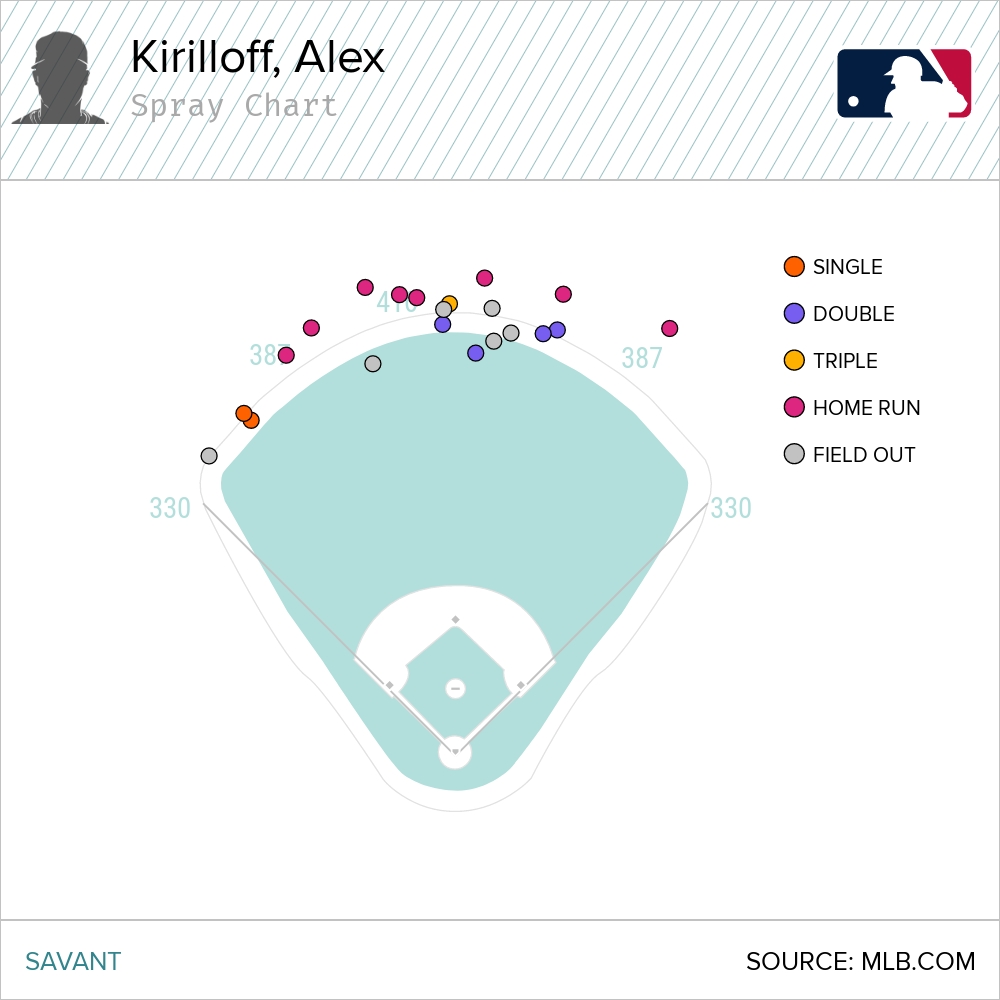
In Alex Kirilloff’s injury-shortened 2021 season, he barreled 21 batted balls. None of those 21 were extremely pulled: one went to straight-away rightfield, and the rest were oppo or right-center to left-center. In a full season of at bats, odds are Kirilloff yanks a few more barrels to rightfield, but in his 200+ AB 2021, the extremity of his barrel-producing up-the-middle approach stands out.
Statcast delineates straight-away CF as the zero-degree horizontal launch direction, with hits to the left of center having a negative horizontal launch direction and hits to the right of center having a positive horizontal launch direction. Kirilloff had one barrel in 2021 with a horizontal launch direction of greater than 10 degrees (a 431-foot shot pulled 19 degrees to the right of center).
How unique was Kirilloff’s barreled-ball horizontal launch angle? On a pitch% basis, his rate for 10 degrees or less horizontal launch angle barrels was 2.4% (i.e., 2.4 barrels between the left field line and 10 degrees right of CF per 100 pitches). The next closest batter was Rafael Devers at 1.7%. Maybe the LHH I most associate with oppo/CF power is Yordan Alvarez. Alvarez is pretty close behind Devers, with a rate of 1.5%. Kirilloff’s rate was more than 50% greater than Alvarez’s and more than 40% greater than Devers’.
The MLB average for LHH batters in 2021 was 0.57%. Kirilloff’s rate was more than four times the average rate for LHHs. Limiting the sample to the batters that had at least five barrels of 10 degrees horizontal launch angle or less, Kirilloff’s rate was nearly five standard deviations greater than the non-weighted average rate for those players (Devers’ rate was only about three SDs greater).
Is this interesting? Does it matter? Maybe.
Sticking to the three young guys mentioned above (Kirilloff is just a year younger than the other two), what sets Alvarez and Devers apart from Kirilloff? Kirilloff walks a bit less, but all three struck out at about the same rate in 2021, so plate discipline is probably not a driving factor.
In addition to Kirilloff’s not pulling hard-hit balls in the air, the primary reason his production trailed the others was his propensity for hitting groundballs in general, and his hitting groundballs when he pulls the ball in particular. Kirilloff’s average exit velocity and max EV lagged his counterparts as well.
| Pulled | Pulled | ||||||
| Name | EV | maxEV | LA | GB% | GB% | FB+LD% | Barrel% |
| Rafael Devers | 92.9 | 114.4 | 13.1 | 41.2% | 53.0% | 47.0% | 15.0% |
| Yordan Alvarez | 93.2 | 116.4 | 14.1 | 37.8% | 58.3% | 41.7% | 15.9% |
| Alex Kirilloff | 91.0 | 108.4 | 7.0 | 48.8% | 70.0% | 30.0% | 12.8% |
Kirilloff injured his wrist in May 2021 and played through the injury for two months prior to getting season-ending surgery in July. While Kirilliff often also had moderately high groundball rates in the minors, it is possible that his wrsit injury contributed to his low average launch angle and high groundball rate in 2021 (and injuries in the minors also impacted his performance, and likely his MiLB GB rate).
Even with the wrist injury and the high rate of groundballs, Kirilloff’s barrel rate was still nearly elite. Kirilloff has the power to exceed 30 HR per season, but his up-the-middle results on flyballs/line drives somewhat limited him in 2021, and his groundball rate severely limited him.
If Kirilloff’s wrist is healthy, he may increase his average EV in 2022, but more importantly he hopefully will be able to make the adjustments necessary to get more lift to the pull side, up his average launch angle into the mid-teens, and lower his rate of pulled groundballs. If he does that, he will likely retain his all-fields power, but will no longer be a complete outlier with 95% of his barrels going to right-center through leftfield; and he may be a viable fantasy and real-world breakout in 2022.
 Jay Stellmach's Fantasy Baseball Musings