

This is the fourth in an at least six-part series of posts going over my 2021 NFBC Draft Champions rosters (at least six parts since I plan on having six or more DC teams). If you missed the first post, second post, and/or third post go ahead and check those out as well – they offer a bit of background on the NFBC DC format, as well as my (brief, yet successful) DC results from 2019 and 2020. One point to briefly repeat here: NFBC rosters lock for pitchers weekly, but allow the hitting lineup to be changed after Thursday each week.
Whereas I did my first three DC drafts more-or-less simultaneously, I had nothing else going on during this one (except for work at the real job, family life, and some time at the beach). Maybe that helped me focus a bit more on this one, but it is hard to say for sure – if it is better (or worse), that probably has as much or more to do with timing (a lot of player signings occurred after my first three drafts were done), as it does with not doing multiple drafts at the same time.
For this draft, I went with my normal inclination and wanted a pick in the 9-12 range…and got my sixth priority (14th). Not ideal, but here is how it went. (ADP cited is for NFBC DC drafts from 1/25 through 2/21.)
Pick 14: Freddie Freeman. There are no bad picks in the first round. A unique and amazing hitter. He is so good, it seems like nobody bothers to analyze him. Or maybe they (we) do, and it is really pretty simple: he consistently hits the ball hard enough, at around the ideal launch angle.
Pick 17: Trevor Story. There are no bad second round picks either, but it is a fateful choice – it can determine the path of the rest of the draft. I skipped SP here, knowing I would not get another crack at one until pick 44. My choice was down to Trevor Bauer or best hitter available (I already have shares of Walker Buehler and Aaron Nola, the other two available SPs worth considering), and, while I am not purposefully avoiding Bauer… on second thought, I kind of am purposefully avoiding Bauer…anyway, I went with best hitter available with sure-thing SBs. This was prior to Bauer signing with the Dodgers, but I think I would have gone with Story regardless.
Pick 44: Zac Gallen. So, I lucked out and Gallen was still on the board. I got Gallen right after Tyler Glasnow and Lance Lynn were taken, and I have Gallen ranked above them (Strasburg, Fried, Carrasco, and Burnes were the next four SPs taken after Gallen).
Pick 47: Randy Arozarena. How real is he? Pretty real. The previous pick was Starling Marte. I wanted the SBs, so I preferred Arozarena over George Springer (and over Trent Grisham due to batting average… I hope). Possibly more pertinent: I didn’t get another SP here. We will see how that strategy plays out (hint: FantasyPros Draft Wizard tells me that my weaknesses are: “W, K, ERA, WHIP”… huh).
Pick 74: Nick Castellanos. He had a weird BABIP year, and also struck out more (due to a lot more swing-and-miss, inside and outside the zone). I did not dig deeper than that, and simply hope he was out of whack due to the weird season.
Pick 77: Eugenio Suarez. 2020 was a very bad BABIP year for Suarez, seemingly due to some luck, and some of what I like to call “being worse” (he traded a bunch of hard contact for medium contact, and most of everything else looks similar). I should have a good enough batting average base to take on Suarez’s BA risk. I jumped both Cincinnati guys (slightly) ahead of ADP, as I did not prefer the SP choices available, and I hoped that I might get a similar quality SP on the next shot.
Pick 104: Ryan Pressley. A good closer, with the job, picked at value.
Pick 107: Zack Greinke. He was pretty good last year, and throwing harder as the year wore on. He’s my SP2? This could work. I don’t have elite strikeouts from my first three pitchers, but it should be enough to hang in there.
Pick 134: Dylan Moore (ADP: 126). My second Dylan Moore share (the first was at pick 102, so I was plenty ok with taking him at pick 134). He made a swing/approach change last year, and it (obviously) worked, at least in the small-sample season of 2020.
Pick 137: Pablo Lopez (ADP: 122). I am beginning to see why my strikeout projection is kind of “meh”. But Lopez did strike guys out last year, and was great, basically – traditional stats are backed up by the advanced / Statcast metrics. His year deserves a deep dive – on the surface, beyond the great results, all that jumps out is his lowering his curveball rate down to 9% and incorporating a cutter.
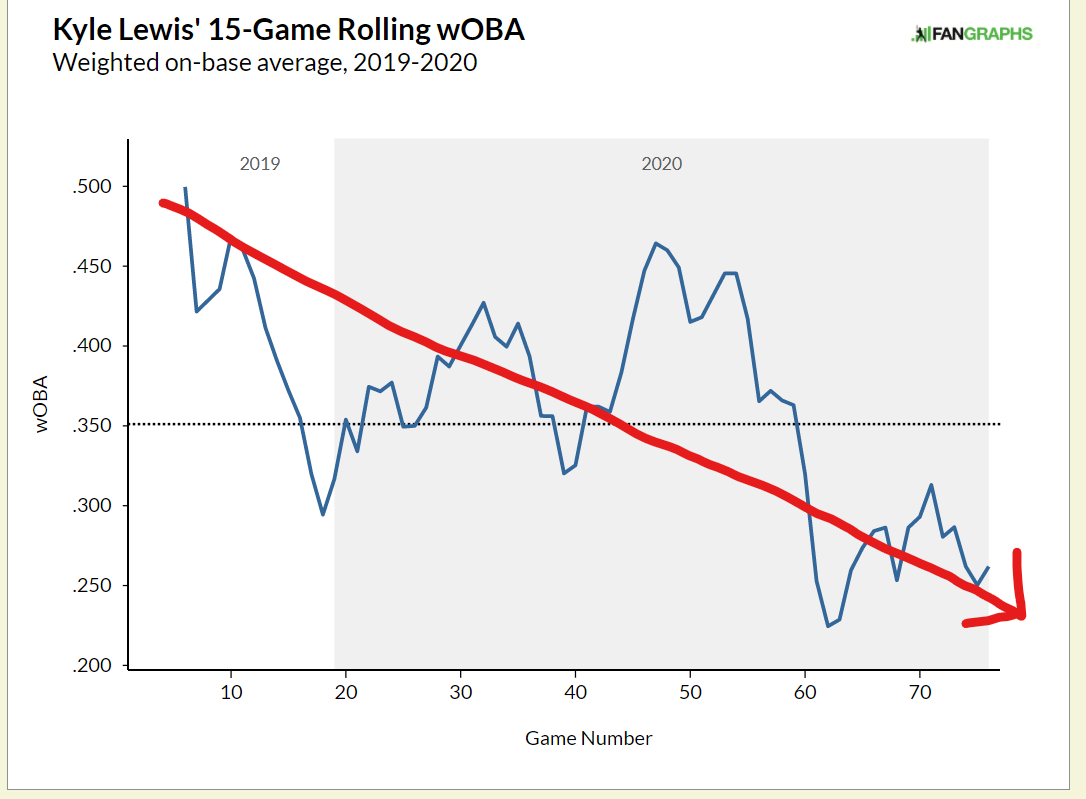
Pick 164: Kyle Lewis (ADP 146). Is he bad? By the end of 2021, his wOBA may be zero (see entirely accurate trend line sketched below). I made some picks late in the draft to attempt to mitigate for the possibility of his being not good.
Pick 167: Nick Solak (ADP: 164). Dual-eligibility (2B/OF) helps. Some power, some speed, should have good BA. The rumblings regarding his defense limiting his playing time are disconcerting, but the bet is he hits enough to make those concerns moot.
Pick 194: Trey Mancini (ADP: 2189). He was great in 2019. No need for speed here, so Mancini’s combo of good power and hopefully good BA fits the bill (and 1B/OF eligible). All the news indicates he is 100% after his season missed to colon cancer treatment.
Pick 197: John Means (ADP: 254). His projections are stinky poop. He will crush them. If he doesn’t? My team may suck.
Pick 224: Buster Posey (ADP 280). I’m all in on Posey. A big advantage of a DC is the ability to handcuff catchers – you don’t want to just burn roster spots, but spending a 28th round pick on Joey Bart (not in this draft) and/or a 37th on Curt Casali? Whatever. It’s worth it to shoot for the upside of Posey over the typical random detritus of the catcher position.
Pick 227: Hunter Dozier (ADP: 238). Dozier had Covid, so I am tossing out his 2020 line. I expect a BA bounce back and good power, with chip-in SBs, along with 1B/OF eligibility (and 3B as well, a week into the season).
Pick 254: Jordan Hicks (ADP: 237). If he is good (good to go, recovering from 2019 TJ surgery, and …good), he is the closer in STL.
Pick 257: Greg Holland (ADP: 227). If things work out, this team will do well in saves. Holland may not be the stud he once was, but he is as sure a bet as any closer outside the top 5 or so (although possibly a late-season trade candidate).
Pick 284: Tom Murphy (ADP: 326). Seriously, people: “over drafting” catchers is worth it in a DC, if you handcuff them (I “over drafted” Luis Torrens at pick 374 (ADP: 434) to pair with Murphy). In one of my DC drafts I may try to mostly punt my C2, but in general, I think it is a pretty bad idea.
Pick 287: Joey Wendle (ADP: 313). 2B/3B/SS eligible. Should supply BA and some SBs. I paired him with Mike Brosseau at pick 434 to mitigate his being somewhat platooned.
Pick 314: Josh Lindblom (ADP: 315). A 5.16 ERA last year, but the underlying stats portend better (3.88 FIP, 87.8 mph average exit velocity), as he was bad with men on base (his wOBA allowed was .079 higher with men on, leading to a 65% strand rate). Hopefully that was mostly random. If so, I like him as my SP5.
Pick 317: Brad Keller (ADP: 318). My SP6. He was supposedly working on a curveball last spring, but ended up not using it in-season. He didn’t need it, but maybe with a more-normal season, we see him give it a try. Whatever the case, he is a fine fantasy SP6, especially since he should be a pretty good bet for a fairly normal IP total, which somewhat makes up for his low K/IP ratio.
Pick 344/347: Andrew Vaughn (ADP: 317) and Adam Eaton (ADP:331). Eaton currently slots in as my last starter, with Vaughn on the bench. I have plenty of roster flexibility to slide Vaughn in at Corner or Utility if he is up and produces.
Notable reserve picks (fully listed in the picture below):
- Luis Arraez in round 26. I had him on multiple teams last year. I knew his drawbacks then, and I certainly still do. But he was also not fully healthy last year, and still hit .321. He also may get OF eligibility early in the season, which counteracts his slight dip in expected playing time (and he also might, generally, slot higher in the lineup than he did last year).
- Bryan Garcia / Gregory Soto (round 27 / round 35). The likely Saves-producers in Detroit. I need to dive into Garcia’s pitch mix from last year, as his 5.0 K/9 does not jive with his career 11.5 minor league K/9.
- Jared Oliva / Anthony Alford (round 28 / round 38). I have a lot of confidence that Oliva is ready and will be good. I drafted Alford just in case Pittsburgh gives him a long leash and he is decent enough to stick and hold off Oliva.
- Randy Dobnak (round 30). He was the Twins expected #5 starter when I made this pick. I follow the Twins closely, so I knew there was a chance he would be bumped to the #6 slot.
- Curt Casali (round 37). The aforementioned Posey insurance.
- Leury Garcia (round 39). Andrew Vaughn / Adam Eaton insurance.
- Taylor Trammell / Jake Fraley (round 41 / round 45). In case Kyle Lewis is bad. Even if Lewis is good, Trammell could be playing nearly full time and providing SBs by mid season.
- Jhoan Duran (round 48). He will be up and contributing to the Twins at some point, and serves as a backup to my Dobnak pick.
- Anthony Misiewicz (round 50). I am one of the few drafting Misiewicz (he was picked in 4 of 44 DC drafts for the ADP period I am citing). A separate post on Misiewicz is forthcoming.

I haven’t run this through any projections. That will be part of a future post where I plan on comparing my DC teams. My first three DCs will be compared to each other as they were mostly simultaneous, and this draft will be compared to those in a separate post.
 Jay Stellmach's Fantasy Baseball Musings